
 0
0
 EN
EN  English
 عربى
عربى Español
 русский
If you need any help, please feel free to contact us
Home / News / Industry News / Ultimate Flow Meter Guide: What It Is, How It Works, Types & Selection
Ultimate Flow Meter Guide: What It Is, How It Works, Types & Selection
Purchasing a flow meter is not a simple “pick a unit and forget it” decision. The wrong device can drive up energy costs, reduce batch consistency, or even create safety problems in a plant. The first conclusion to understand: a flow meter is an instrument that measures the flow rate of a fluid passing through a pipe, but it is not a universal component. Every technology has a set of conditions where it performs well and another where it will fail. This guide explains what a flow meter is, how it works, and what you need to verify before buying one.
What Is a Flow Meter? How Does It Work?
A flow meter, also called a flow sensor, is an instrument that measures the amount of fluid moving through a pipe. That fluid can be liquid, gas, or steam. The output can be expressed as a volumetric flow rate, such as liters per minute or cubic meters per hour, or as a mass flow rate, such as kilograms per second. The distinction matters because gas volume changes with pressure and temperature, while mass does not.
Most flow meters work by converting a fluid property into a measurable signal. A vortex flow meter, for example, uses a bluff body placed in the flow path. As fluid passes the body, vortices are shed alternately on each side. The frequency of this vortex shedding is proportional to the fluid velocity. An electromagnetic flow meter works differently: it applies a magnetic field across a conductive liquid, and the induced voltage is proportional to the flow velocity. A Coriolis meter twists a vibrating tube when fluid flows through it, and the degree of phase shift correlates directly with mass flow.
Because the sensing mechanisms differ, no single meter can deliver accurate results for every fluid and every process condition. This is why selection starts with process data, not with a product model.
How to Choose a Flow Meter: Key Selection Criteria
Before comparing technologies, write down the conditions that the meter will see in operation. The following list covers the minimum information that a supplier’s application engineer will need.
- Fluid type: Is it liquid, gas, or steam? Is it electrically conductive, corrosive, viscous, or containing solids or bubbles?
- Process temperature and pressure: Continuous operating conditions and any peak or upset values.
- Flow range: Minimum, normal, and maximum flow rates, plus the expected turndown ratio.
- Accuracy requirement: Is this for process control, energy accounting, or custody transfer?
- Pipe size and installation space: Straight pipe run available upstream and downstream, and the orientation of the installation.
- Environment: Indoor or outdoor, hazardous area classification, vibration level, electromagnetic interference.
These parameters define whether a meter will hold calibration in the field. For example, a gas line with low pressure and a narrow flow range often benefits from a swirl or vortex meter, while a slurry line containing solids is better served by an electromagnetic meter because it has no moving parts or small bore restrictions.
Common Flow Meter Types Explained
| Type | Typical Fluids | Key Advantage | Main Limitation |
|---|---|---|---|
| Vortex | Liquids, gas, steam | No moving parts, low maintenance | Sensitive to pipeline vibration |
| Swirl | Gas, compressed air | Good in small gas lines, can include temp/pressure compensation | Largely limited to clean gases |
| Coriolis | Liquids, gases, slurries | Direct mass flow, high accuracy | Higher initial cost, pressure drop |
| Electromagnetic | Conductive liquids, slurries | No obstruction in the pipe, excellent for dirty media | Requires a minimum conductivity |
| Turbine | Clean liquids and gases | Very repeatable, fast response | Moving parts may require maintenance |
Vortex Flow Meters
Vortex meters are a strong choice for steam, gas, and many liquids. They can operate at high temperatures and pressures, and because there are no moving parts inside the sensor, they are popular in process industries where reliability matters. Installation requires a minimum straight run upstream and downstream. Excessive vibration in the piping can affect the signal, so the meter should be shielded or isolated from mechanical noise.
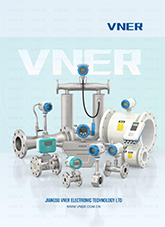 MA80T Series Vortex Flowmeter for Steam, Gas, and Liquid ApplicationsThe MA80T vortex flowmeter measures steam, gases, and liquids using the Kármán vortex principle, offering reliability with no moving parts and suitability for high-temperature, high-pressure process industries.View Product →
Swirl Flow Meters
Swirl meters are particularly useful in clean gas applications where the line is small and the flow rate is low. They generate a swirling flow pattern, and the precession frequency of the vortex core is proportional to fluid velocity. A built-in temperature and pressure compensation variant like the SA80TTP can correct for changing gas conditions without additional instrumentation.
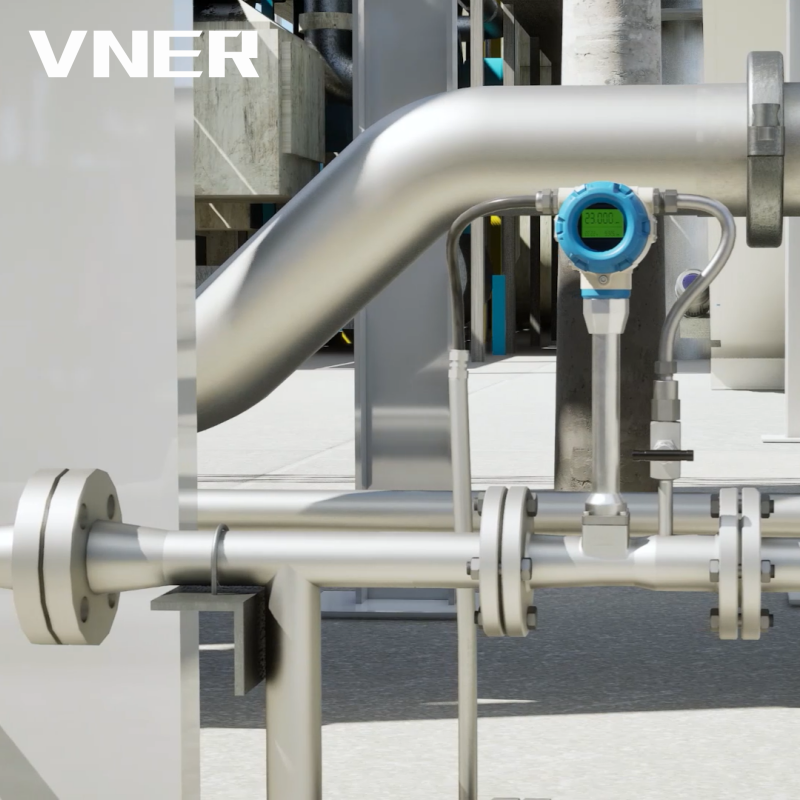 SA80T Series Swirl Flowmeter for Clean Gas and Low Flow RatesThe SA80T swirl flowmeter is ideal for clean gas applications with small lines and low flow rates, providing accurate measurement via vortex precession, with a compensated variant for changing gas conditions.View Product →
Coriolis Mass Flow Meters
Coriolis meters measure actual mass flow directly, not inferred volume. This makes them invaluable for chemical dosing, custody transfer, and quality control where mass is the real quantity of interest. They handle both liquids and gases, and they can be applied to fluids with changing density. The trade-off is a higher purchase price and a pressure drop related to the tube geometry.
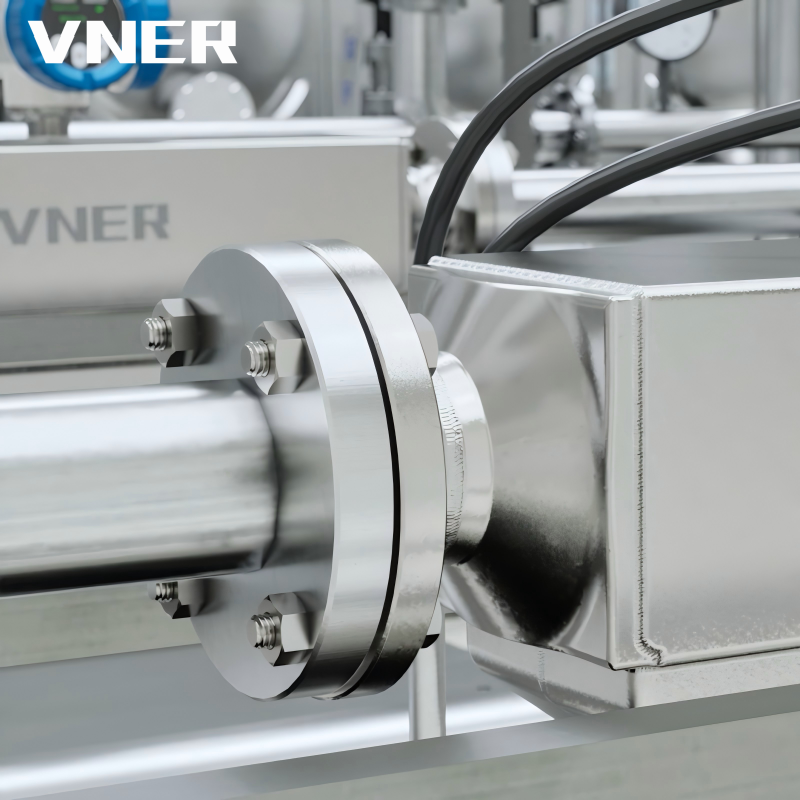 AC Series Coriolis Mass Flowmeter for Direct Mass Flow and DensityThe AC Series Coriolis meter directly measures mass flow, density, and temperature, making it essential for chemical dosing and custody transfer where accurate mass measurement is critical.View Product →
Electromagnetic Flow Meters
Electromagnetic meters are built for conductive liquids and slurries. The flow tube has no moving parts, and the pipe lining is the only component in contact with the fluid. This makes them ideal for water, wastewater, mining slurries, and many chemical streams where high solids content would damage a turbine or vortex sensor. They require a minimum electrical conductivity and a fully filled pipe.
Industrial Applications and Real-World Buying Considerations
Flow meters operate in process industries such as oil and gas, petrochemical, polysilicon, power generation, and water treatment. In these environments, the meter is not isolated in a lab; it sees pipe vibration, temperature swings, condensation, entrained air, and deposits. A meter that is not sized for the actual fluid viscosity or that lacks the right housing material will drift over time, causing downtime and unplanned maintenance.
The adoption of industrial automation continues to demand reliable sensors that can communicate with control systems. This is reflected by the growing integration of flow sensors into connected process equipment. For a plant engineer, the practical implication is to select a meter with a proven output interface, such as 4–20 mA, HART, pulse, or a communication protocol supported by the existing control system. Installing a flow meter that cannot communicate with the DCS is a serious workflow problem. Demand for these capabilities has increased across many process industries, and suppliers are responding with instrumentation designed for wired and wireless plant networks.
Another decision factor is the supplier’s ability to support engineering-driven sizing and selection. A 23,000 m² manufacturing base, a dedicated technical team, and a track record of projects in more than thirty countries are indicators that the supplier can handle specification reviews and delivery requirements. If you are working with an EPC contractor or an OEM, matching the meter to the project schedule and documentation is as important as the meter’s accuracy specification. Understanding the manufacturer’s capabilities before placing an order reduces the chance of unexpected delays or mismatched hardware.
When you are evaluating a manufacturer, check that they can provide calibration certificates, material certificates, and support for hazardous area approvals. Ask about spare parts availability and whether the sensor electronics can be serviced field-side or must be returned to the factory. A competitive price means little if the meter has a six-week lead time for a replacement part. For these reasons, learning about the manufacturer’s manufacturing and project background is a practical step before confirming a purchase.
Before you approve a flow meter purchase, write down the process conditions and target accuracy. Then compare the technologies against that data, not against marketing claims. The right flow meter is not necessarily the most expensive one; it is the one that matches your fluid properties, installation constraints, and long-term reliability expectations. If you need help with sizing or installation, talk to the manufacturer’s application engineers. The most expensive mistake in flow measurement is choosing the wrong technology and living with the consequences for the lifetime of the plant.

We offer all our products and services at international standards.
Products
Contact Information
-

+86 18652789521
+86-0514-83633600 / 83633900 -

+86-0514-83633600 / 83633900
-

s@vner.com.cn
info@vnerflow.com -

No. 11 Xingye Road, Chenji Town Industrial Park, Yizheng, Yangzhou, China
