
 0
0
 EN
EN  English
 عربى
عربى Español
 русский
If you need any help, please feel free to contact us
Home / News / Industry News / Converting Volumetric Flow Rate to Mass Flow Rate: A Process Engineer's Guide
Converting Volumetric Flow Rate to Mass Flow Rate: A Process Engineer's Guide
The morning production meeting at a mid-sized chemical plant started with the same discrepancy that had appeared on every shift report for the past month. The reactor feed line was metered by a positive-displacement meter reading in cubic meters, and the control system multiplied that reading by a fixed density of 865 kg/m³ taken from a handbook for light naphtha. The night shift reported a total feed of 1,185 tonnes; the day shift, using the same meter but a temperature-corrected density, counted 1,142 tonnes. The 43-tonne gap was not instrument noise. The line had run between 28 and 41°C over the previous month, while the handbook value was specified at 20°C.
That gap is the price of converting volumetric flow rate to mass flow rate with a density value that does not represent the actual process condition.
The conclusion in advance: mass flow equals volumetric flow multiplied by density. The conversion is only as good as the density value that feeds the calculation. When fluid density is stable and known within the accuracy you need, a volumetric meter plus a reliable density number is a sound and economical solution. When temperature, pressure, or composition moves the density beyond that tolerance, the calculated mass flow loses accuracy, and direct mass flow measurement, usually with a Coriolis meter, is the better engineering choice. This article explains the relationship, the units, the operating conditions that break the calculation, and how to decide which approach fits your process.
Why the Volume-to-Mass Conversion Matters
Process engineers express material balances in mass because mass is conserved. Volume is not. A cubic meter of gas at 10 bar abs holds roughly ten times the mass of the same volume at atmospheric pressure. A cubic meter of hot condensate weighs less than a cubic meter of cold water. Plants receive raw materials, convert them in chemical reactions, and ship products; the entire accounting system works in kilograms and tonnes because those units survive pressure and temperature changes without distortion.
Three obligations make the conversion necessary in practice:
- Chemical reaction control. Reactor feed ratios are specified in moles or kilograms. If a pump moves 5 m³/h of a monomer whose density varies by 3% with storage temperature, the reactor receives about 150 kg/h more or less depending on the season. The volumetric reading alone cannot tell the operator whether the feed ratio is correct.
- Custody transfer and billing. Refined fuels, liquefied gases, and natural gas are traded on a mass or energy basis. A volumetric meter paired with an incorrect density shifts value between buyer and seller. A 1% density error on a 40 t/h stream operating 8,000 hours per year misallocates 3,200 tonnes of product every year.
- Environmental reporting. Emission calculations start from fuel or raw material mass. A 2% understatement of mass flow becomes a 2% understatement of reported emissions, which is often outside the acceptable tolerance of the reporting framework.
These are not theoretical concerns. In purchasing decisions, comparing a volumetric meter with a 0.5% volume accuracy against a Coriolis meter with a 0.2% mass accuracy is not merely comparing 0.5 with 0.2. The volumetric meter’s mass output carries the additional uncertainty of the density assumption, so the real comparison is between a value that needs an external density reference and a value that does not.
Flow meter suppliers organize their product lines around this distinction. VNER, a process flow meter manufacturer, for example, produces vortex, turbine, swirl, and electromagnetic meters that measure volume, and it also builds Coriolis meters that measure mass directly. Maintaining both families in one catalog is a practical recognition that neither principle solves every application. The decision should be made during instrument selection, because retrofitting compensation later is more expensive than choosing the right measuring principle at the start.
The Fundamental Relationship Between Volumetric and Mass Flow
All conversions reduce to a single equation. Mass flow rate (ṁ) equals volumetric flow rate (Q) multiplied by fluid density (ρ):
ṁ = ρ × Q
In metric process units, mass flow is expressed in kilograms per hour, volumetric flow in cubic meters per hour, and density in kilograms per cubic meter. The same relationship holds in any consistent unit system, such as pounds mass per minute, cubic feet per minute, and pounds mass per cubic foot.
The equation follows directly from the definitions of the quantities. Volumetric flow through a pipe is the cross-sectional area A multiplied by the average flow velocity v, so Q = A × v. The mass crossing that section in one second is the density multiplied by the same volume, giving ṁ = ρ × A × v = ρ × Q. There is no additional factor, no hidden constant, and no correction for meter size. The only practical difficulty is obtaining the correct value of ρ at the actual operating conditions.
For cold water the conversion is almost trivial. At 10 m³/h and 998 kg/m³ (water at about 20°C), the mass flow is 9,980 kg/h. For a light oil with a specific gravity of 0.85, the same volumetric flow gives 8,500 kg/h at 15°C. But if the oil reaches 40°C, its density may drop to roughly 835 kg/m³, and the same 10 m³/h is only 8,350 kg/h. An engineer who keeps the 15°C density in the control system overstates the mass flow by 1.8%. That error is not a meter error; it is a density application error.
Unit conversion is where many miscalculations enter. The two tables below summarize the most common conversions.
| Unit | Symbol | Multiply by to get m³/h |
|---|---|---|
| Cubic meter per hour | m³/h | 1 |
| Liter per minute | L/min | 0.06 |
| Cubic meter per second | m³/s | 3,600 |
| US gallon per minute | gpm | 0.227 |
| Cubic foot per minute | cfm | 1.699 |
| Unit | Symbol | Multiply by to get kg/h |
|---|---|---|
| Kilogram per hour | kg/h | 1 |
| Kilogram per minute | kg/min | 60 |
| Kilogram per second | kg/s | 3,600 |
| Metric tonne per hour | t/h | 1,000 |
| Pound per hour | lb/h | 0.454 |
| Pound per minute | lb/min | 27.216 |
To combine the tables: convert the volumetric reading to m³/h, multiply by density in kg/m³, and the result is kg/h. For example, a flare-gas meter reading 5,000 cfm at an actual operating density of 8 kg/m³ becomes 5,000 × 1.699 = 8,495 m³/h, then 8,495 × 8 = 67,960 kg/h.
Datasheets often give specific gravity (SG) instead of density. For liquids, SG is referenced to water at 4°C, which has a density of 1,000 kg/m³, so ρ = SG × 1,000 kg/m³. For gases, SG is referenced to air at the same pressure and temperature, and the actual density must be calculated from the reference air density at those conditions. Always verify which reference is used before applying an SG value.
Density: The Variable That Decides Everything
Density is where the volumetric-to-mass conversion becomes vulnerable, because density is not a fixed property of a fluid. It changes with temperature, pressure, and composition. The magnitude of those changes determines whether the simple multiplication is accurate enough for the application.
Liquids: Near-Incompressible but Thermally Active
Liquids are nearly incompressible; pressure has little effect on density for typical process liquids. Temperature, however, matters. Water at 4°C has a density of about 1,000 kg/m³, at 50°C about 988 kg/m³, and at 80°C about 972 kg/m³. Applying a fixed 20°C value to an 80°C process introduces about a 2.6% mass error. Hydrocarbons behave similarly, with volumetric expansion coefficients in the range of 0.0007 to 0.001 per °C. A fuel stream that swings through a 25°C seasonal temperature range changes density by roughly 1.8% to 2.5%. If the volumetric meter itself is accurate to 0.5%, the density term is several times larger than the instrumental error.
Gases: Pressure and Temperature Dominate
For gases, the simple multiplication fails entirely unless operating pressure and temperature are known. The ideal gas law gives ρ = P × MW / (Z × R × T), where P is absolute pressure, MW is molecular weight, Z is compressibility, R is the gas constant, and T is absolute temperature. At constant molecular weight, density is directly proportional to absolute pressure and inversely proportional to absolute temperature. Air at 20°C and 1.013 bar abs has a density of about 1.204 kg/m³. Compressed to 7 bar abs at the same temperature, its density becomes about 8.43 kg/m³. A volumetric meter reading 100 m³/h at the low-pressure condition corresponds to 120 kg/h of air; the same 100 m³/h at 7 bar corresponds to 843 kg/h. The volume reading means nothing for mass unless pressure and temperature are applied.
Composition: The Silent Density Driver
Composition changes density even at fixed pressure and temperature. Natural gas provides the clearest industrial example: pipeline gas from one field may have a molecular weight of 16.5, while gas from another region with a higher share of heavier hydrocarbons reaches 19.5. That is approximately an 18% difference in density, and therefore an 18% difference in mass flow for the same measured volume. Refinery streams change density when product grades change. Slurries vary with solids concentration; a tailings line at 30% solids by mass has a density well above the carrier water, and assuming clear-water density under-reports the transported mass by 10% to 20%.
Steam: The Sharpest Density Gradient
Steam deserves special attention because its density is extremely sensitive to pressure near the saturation line. Dry saturated steam at 10 bar abs has a density of about 5.1 kg/m³. At 8 bar abs it is approximately 4.2 kg/m³, and at 12 bar abs about 6.1 kg/m³. A 1 bar pressure fluctuation on a 10 bar line changes density by roughly 8% to 9% in the saturated region. A volumetric meter reading in m³/h is nearly useless for saturated steam unless it is paired with a fast pressure measurement, an accurate temperature or pressure input for steam tables, and a calculation that updates continuously.
| Fluid | Condition | Density (kg/m³) |
|---|---|---|
| Water | 4°C, 1 atm | 1,000 |
| Water | 50°C, 1 atm | 988 |
| Water | 80°C, 1 atm | 972 |
| Diesel fuel | 15°C, typical grade | ~840 |
| Air | 0°C, 1 atm | 1.293 |
| Air | 20°C, 1 atm | 1.204 |
| Air | 20°C, 7 bar abs | 8.43 |
| Natural gas (methane) | 0°C, 1 atm | 0.717 |
| Dry saturated steam | 10 bar abs | 5.1 |
The table is not a substitute for process data; it shows the range of conditions that make the density term decisive. When the normal operating envelope moves the density by more than about 1% to 2%, a fixed-density mass calculation will not meet tight accuracy targets.
Standard Conditions and the Trap of Normal Units
One of the most frequent sources of error in gas metering is the use of normal or standard volume units. A normal cubic meter (Nm³) of gas is defined as the volume the gas would occupy at a fixed reference condition, usually 0°C and 1.01325 bar abs in European usage. Standard cubic meters (Sm³) may reference 15°C, 20°C, or 60°F depending on the industry and country. Standard cubic feet per minute (scfm) in the American gas industry references 14.696 psia and 60°F.
These units are mass units in disguise. When someone specifies 1,000 Nm³/h of natural gas, they mean the quantity of gas that would fill 1,000 cubic meters at 0°C and 1 atm. Because the density at that reference condition is known for a given composition, the mass flow is simply the reference density times the normal volume flow.
The trap appears when a normal volume flow is treated as an operating volume. Take 1,000 Nm³/h of air at 0°C and 1 atm, which is 1,293 kg/h. At an operating condition of 30°C and 2 bar abs, the same mass occupies about 555 m³/h of actual volume. If an operating-volume meter reads 1,000 m³/h and the engineer multiplies by the reference density of 1.293 kg/m³, the result is 1,293 kg/h, while the true mass flow at 30°C and 2 bar is approximately 2,330 kg/h. The 80% error has nothing to do with the meter; it comes from mixing actual and reference volumes.
| Convention | Temperature | Pressure | Air density | Methane density |
|---|---|---|---|---|
| European normal cubic meter (Nm³) | 0°C | 1.01325 bar abs | 1.293 kg/m³ | 0.717 kg/m³ |
| ISO standard cubic meter | 15°C | 1.01325 bar abs | 1.225 kg/m³ | 0.678 kg/m³ |
| US standard cubic foot (scf) | 60°F | 14.696 psia | 1.224 kg/m³ | 0.677 kg/m³ |
| Common sales reference | 20°C | 1.01325 bar abs | 1.205 kg/m³ | 0.667 kg/m³ |
At first glance the reference densities in the table look similar, but the difference between a 0°C and a 20°C reference is about 7.3% in air density. If two organizations in a gas transaction use different reference temperatures, the same meter reading produces mass values that differ by several percent, entirely independent of measurement performance. The practical rule: confirm the reference temperature and pressure of any normal or standard volume, and convert all documents to a single common reference before comparing numbers.
Also verify whether the flow meter datasheet states operating volume (actual m³/h) or normalized volume. Vortex, swirl, electromagnetic, and turbine meters output actual operating volume. When their signal is used for a mass calculation on gas, the operating density, not the reference density, must be applied to the actual volume.
When Calculated Conversion Works, and When It Does Not
The practical conclusion is that the calculated conversion works when density is stable or accurately corrected, and fails when density moves faster than the compensation model can follow.
Calculated conversion works acceptably in these situations:
- Water and aqueous solutions at controlled temperatures, where density changes are small, well documented, and easily corrected with a temperature transmitter.
- Stable single-phase liquids held at nearly fixed temperature, such as distillation side draws and heat-exchanged intermediates, where density uncertainty is about 0.1% to 0.2%.
- Plant air and utilities at regulated pressure, where a pressure regulator holds density within a few percent and the required mass accuracy is modest.
- Batch loading with laboratory density measurement, where each batch is sampled and the hydrometer value is entered into the calculation.
The same approach does not work for:
- Saturated steam, where density changes by roughly 0.6% to 1% for every 0.1 bar of pressure change near typical process pressures, and where slow or inaccurate pressure correction produces mass errors of 5% or more.
- Gas lines with variable pressure, where each compressor cycle or valve adjustment moves density immediately and the mass output is wrong by exactly the pressure ratio error unless live compensation is applied.
- Two-phase flow, where no single density value can represent the mixture and both volume and density are undefined.
- Slurries and suspensions with changing solids concentration, where the density varies continuously and a fixed value produces errors of 10% to 20%.
- Cryogenic liquids such as LNG, where small composition and temperature shifts cause large density changes.
Quantitatively, the mass flow uncertainty of the calculated approach is the root-sum-square of the volumetric uncertainty and the density uncertainty. If a vortex meter contributes 1% and the density is known to 0.5%, the combined mass uncertainty is about 1.1%. If the density uncertainty grows to 3%, the combined value becomes about 3.2%. The density term quickly dominates the total. That is why pressure/temperature compensation is paired with volumetric meters in steam and gas service: it reduces the density uncertainty to roughly 0.5% to 1%, pulling the total below the range that is acceptable for many monitoring duties.
Vortex meters such as the MA80T series measure the actual volume flowing through the pipe, and they can be equipped with pressure and temperature inputs to estimate mass flow when the fluid behavior is predictable. The engineering question is whether the compensation model matches the real fluid across the entire operating range, including start-up, turndown, and upset conditions. If it does, the calculated solution is defensible; if it does not, direct mass measurement is the safer path.
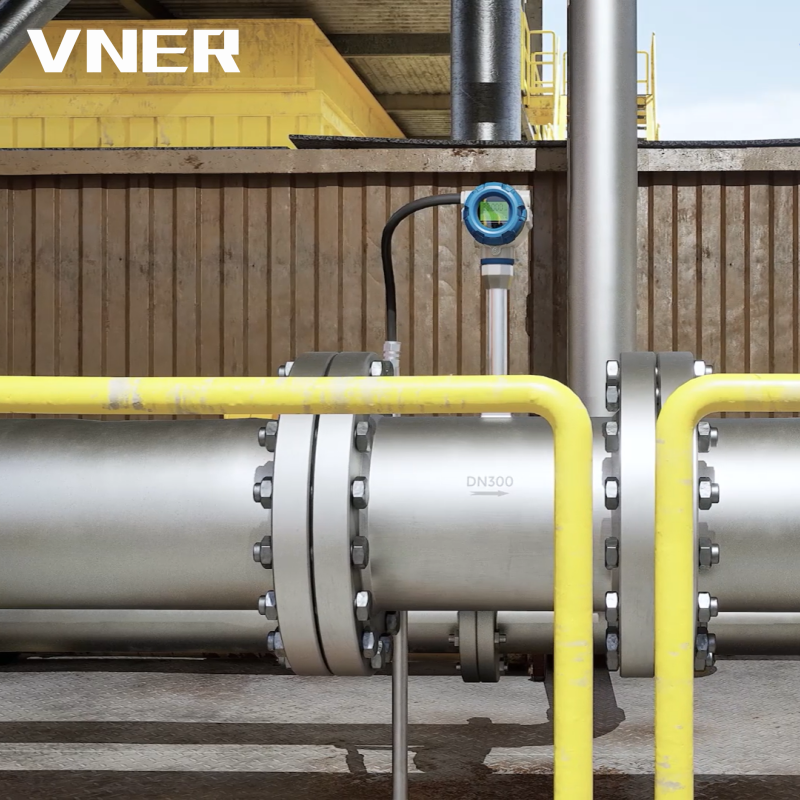 MA80T-TP Series Compensated Vortex Flowmeter for Steam and GasThis temperature- and pressure-compensated vortex meter derives mass flow and standard volume from the measured volumetric flow, making it a practical alternative when fluid density is predictable but direct mass measurement is not required.View Product →
Direct Mass Flow Measurement: The Coriolis Solution
When density cannot be pinned down well enough, the process industry turns to the Coriolis mass flow meter, an instrument that measures the force exerted by a moving fluid rather than the volume it occupies. In a Coriolis meter, fluid flows through one or two tubes that vibrate at their natural frequency. The moving fluid experiences a Coriolis acceleration, which distorts the vibration pattern by an amount directly proportional to the true mass flow rate. Sensors at the inlet and outlet legs of the tube measure the phase difference; that phase difference is a direct mass flow signal, independent of density, pressure, temperature, viscosity, and flow profile. The natural frequency of the tube also depends on the mass inside it, which lets the same instrument report fluid density continuously.
The practical consequence is important. A Coriolis meter does not require the operator to enter a density value, does not need pressure and temperature compensation for its mass output, and does not lose accuracy when composition drifts. Modern Coriolis meters achieve approximately 0.1% to 0.5% of rate accuracy for liquids, with repeatability of 0.05% or better, which is why they are accepted for many custody transfer applications. The density output, typically accurate to about 0.5 to 1 kg/m³, can replace a separate densitometer and provides a continuous check on product quality.
Coriolis meters also work for gases, with two caveats. Gas density is low, so the mass inside the sensor is small, and the meter must be sized for the expected mass load rather than the line size. The tube bank also creates more pressure drop than a straight-bore volumetric line. An experienced measurement engineer can explain in more detail how a Coriolis mass flow meter works and what to watch for in gas and liquid applications. The selection for gas service always involves a trade-off between low-flow sensitivity and pressure drop.
For slurries and moderately settling suspensions, Coriolis meters generally outperform volumetric meters because the mass signal is not affected by the velocity profile or the solids carried along with the liquid. Heavy settling slurries still require careful installation to avoid accumulation. For clean liquids, blends, and reactive feeds, the direct mass output removes the largest single source of error in the calculated approach, which is the density assumption. VNER offers the KSMF-S series Coriolis mass flow meter for process duties where direct mass output and continuous density monitoring are required, including chemical feed, fuel supply, and blending service.
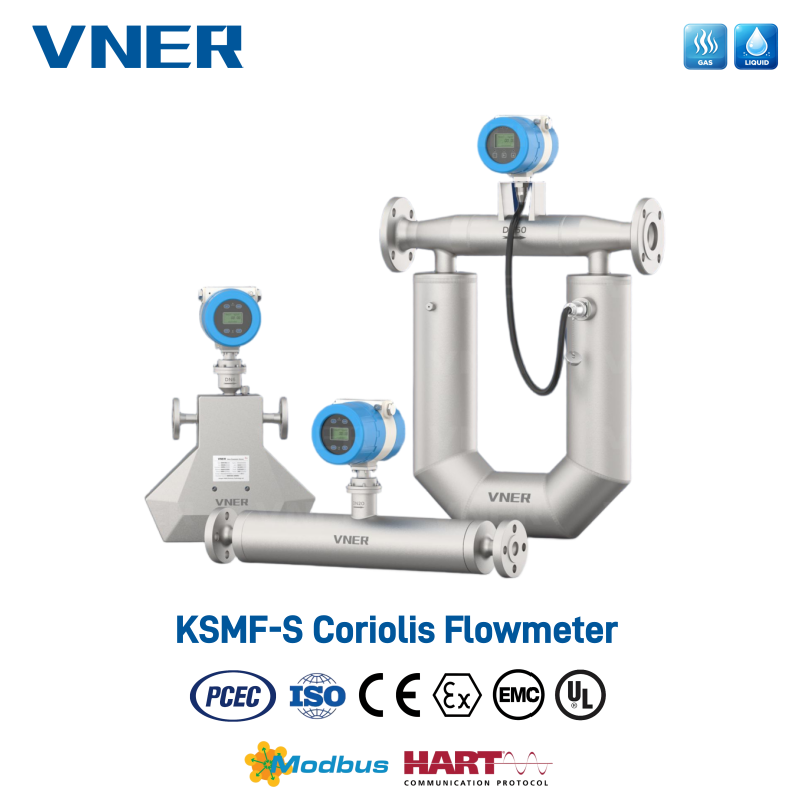 KSMF-S Series Straight-Tube Coriolis Mass Flowmeter for Process DutyFeaturing straight dual tubes, this Coriolis meter provides direct mass flow and density with low pressure loss, low shear, and easy cleaning, making it suitable for viscous fluids, hygienic lines, and chemical feed applications.View Product →
Selecting the Right Approach for Your Process
The choice between a calculated conversion and direct mass measurement reduces to four questions:
- What accuracy is actually required? Process monitoring can tolerate 2% to 3%; custody transfer and critical reactor ratio control need 0.2% to 0.5% or better.
- How much does density vary across the operating envelope? If the variation is less than about 1% to 2% and can be measured, the calculation approach works. If it is larger, or if composition changes, direct mass measurement is safer.
- Can the system accept the pressure drop of a Coriolis meter? Gas service with limited available head may favor a low-pressure-drop volumetric meter with compensation, while liquids and slurries tolerate the higher pressure drop more easily.
- What is the lifecycle cost of an error? The calculation must include misallocated product, off-spec batches, and emission penalties, not only the initial meter price.
An economic example puts the choice in perspective. A terminal transfers 30 t/h of a refined product for 8,000 hours per year. A calculated-mass error of 1.5%, combining a 0.7% volumetric meter with a 1.3% density error, misallocates 3,600 tonnes per year. At $600 per tonne, that is $2.16 million annually in measurement error on a single line. The additional cost of a Coriolis meter is recovered quickly when the product value is high. For monitoring duties on stable water or utility air, a vortex or electromagnetic meter with a well-established density constant remains sound engineering.
| Factor | Volumetric meter + density calculation | Direct mass (Coriolis) |
|---|---|---|
| Mass output | Needs density input or PTZ compensation | Intrinsic, independent of density |
| Typical mass accuracy | 1–3% with fixed density; 0.5–1.5% with compensation | 0.1–0.5% for liquids |
| Density sensitivity | High | None for mass output |
| Pressure drop | Low | Moderate, higher for gases |
| Turndown | 10:1 to 20:1 typical | 50:1 and above |
| Moving parts | Some designs (turbine, positive displacement) | None |
| Density output | Requires separate densitometer | Included |
| Relative initial cost | Lower | Higher |
After the measuring principle is chosen, sizing becomes the deciding factor. Volumetric meters must operate within their specified velocity and Reynolds number range to hold their rated accuracy. A vortex meter sized for 100 m³/h loses turndown at 20 m³/h because the vortex shedding signal weakens. Coriolis meters are sized by mass flow and allowable pressure drop, which means the meter size does not follow the piping size automatically. A gas line of DN200 may require a DN50 or DN80 Coriolis meter to keep the velocity and pressure drop within limits.
For users moving toward direct mass measurement in dosing, blending, or general process duty, the AC series Coriolis mass flow meter from VNER provides another Coriolis option, with the same fundamental principle of direct mass output. The choice between the KSMF-S and AC series depends on capacity, connection size, and fluid compatibility, and it should be confirmed with process data rather than decided by habit.
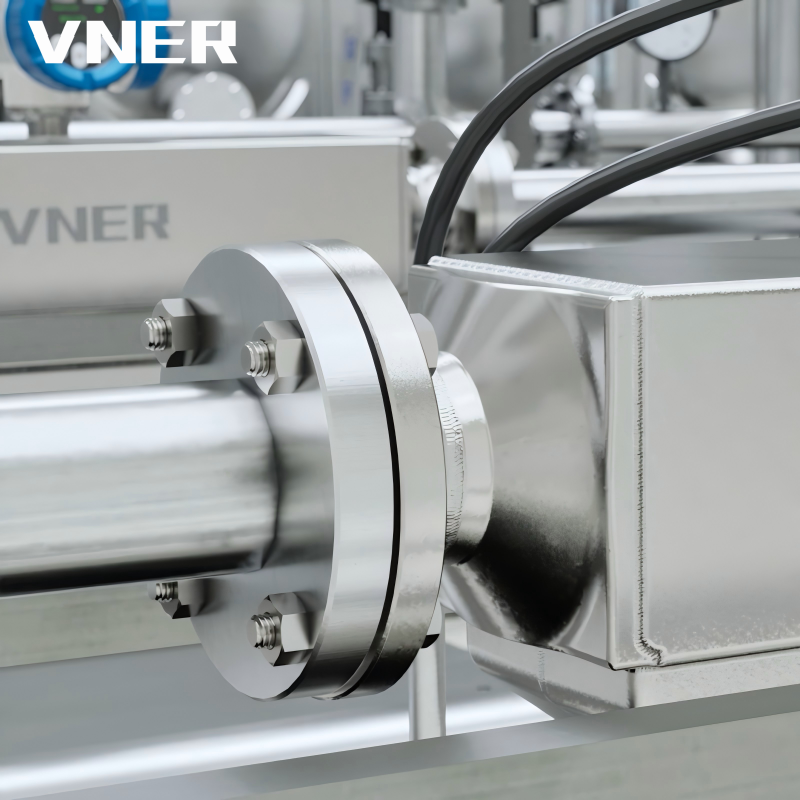 AC Series Coriolis Mass Flowmeter for High-Value Fluid ManagementAs VNER’s flagship Coriolis line, the AC Series directly measures mass flow, density, and temperature in a compact, low-pressure-loss design suited to custody transfer, critical process control, and demanding industrial environments.View Product →
Final Takeaway: Choose Based on Density Stability
Volumetric flow rate and mass flow rate are connected by one equation, but the reliability of that connection depends entirely on the density term.
The decision rule is compact. Use a volumetric meter with calculated mass flow when the fluid is clean, single-phase, and density is stable or corrected by live measurements; the accuracy will be sufficient for most control and monitoring duties. Use a direct mass flow meter when density changes with process conditions, when the product is traded or billed by mass, or when material-balance accuracy is an explicit plant objective.
Instrument selection for flow measurement is not a catalog exercise. It requires process data, unit discipline, and honest estimation of the density uncertainty over the full operating range. Suppliers who perform engineering-driven sizing and selection, based on the actual conditions of the application, provide the information needed to make the decision correctly.
The next time a morning report shows a 43-tonne gap, look first not at the meter alone but at the calculation behind the numbers. Density determines whether the conversion holds. When density is respected, the volumetric-to-mass conversion is reliable; when it is ignored, even the best volumetric meter will tell a story that the mass balance does not accept.


Products
Contact Information
-

+86 18652789521
+86-0514-83633600 / 83633900 -

+86-0514-83633600 / 83633900
-

s@vner.com.cn
katherine@vner.com.cn -

No. 11 Xingye Road, Chenji Town Industrial Park, Yizheng, Yangzhou, China
