
 0
0
 EN
EN  English
 عربى
عربى Español
 русский
If you need any help, please feel free to contact us
Home / News / Industry News / Electromagnetic Water Flow Meters: Working Principle, Advantages, and Selection Guide
Electromagnetic Water Flow Meters: Working Principle, Advantages, and Selection Guide
In a water treatment plant, the difference between accurate and inaccurate flow measurement shows up directly in chemical dosing, pump efficiency, and regulatory compliance. That is why engineers responsible for clean water, raw sewage, and sludge lines often choose an electromagnetic water flow meter. It measures flow by inducing a magnetic field and reading the voltage produced by the moving conductive liquid, giving a stable measurement without moving parts. This article explains how these meters work, why they suit water applications, what limits they have, and how to choose one for your system.
What Is an Electromagnetic Water Flow Meter?
An electromagnetic flow meter, often called a mag meter, is a volumetric flow instrument designed for conductive liquids. It consists of a non-magnetic measuring tube, two or more excitation coils, and electrodes that contact the liquid. The tube is lined with an insulating material so that the electrodes only see the voltage generated by the liquid moving through the magnetic field, not by the pipe wall.
For water applications, the term "electromagnetic water flow meter" typically refers to a mag meter sized and configured for drinking water, wastewater, cooling water, or industrial process water. Most water supplies have enough dissolved minerals to pass the minimum conductivity requirement of about 5 microsiemens per centimeter, which is why mag meters work so well in water systems. Even municipal wastewater and secondary-treated effluent generally fall well above that threshold.
How Does an Electromagnetic Water Flow Meter Work?
The operating principle is based on Faraday's law of electromagnetic induction. When a conductive liquid flows at a velocity V through a magnetic field B generated across the pipe, the moving liquid acts like a conductor and induces a voltage E between the electrodes. The voltage is proportional to the average flow velocity, the magnetic flux density, and the distance between electrodes, which is essentially the pipe diameter.
For water and wastewater, this principle makes the meter highly repeatable. The output is independent of temperature, viscosity, and density. Once the meter is calibrated with water, it can be used on other conductive liquids without additional correction, as long as the pipe is full and the liquid conductivity stays within the required range. In practice, the measured voltage is very small, so modern transmitters amplify and digitize it before converting it into a flow reading or a standard analog signal.
Key Advantages of Electromagnetic Water Flow Meters
Electromagnetic water flow meters are selected in many municipal and industrial water installations because they offer a set of benefits that are hard to match with mechanical meters.
- No moving parts: there are no impellers, turbines, or seals to wear out, leading to low maintenance and long life.
- High accuracy: typical uncertainties range from 0.2% to 0.5% of reading, depending on the model and calibration.
- Low pressure drop: the open bore creates almost no obstruction, so pumping energy is conserved.
- Bi-directional measurement: the meter can measure flow in both directions, which is useful for lines that may reverse.
- Resistance to debris and solids: the open design passes solids that would clog a mechanical meter, making it suitable for raw sewage and sludge.
- Digital output stability: the induced voltage signal is linear with flow, so no square-root extraction is needed.
In practice, the no-moving-parts feature is often the deciding factor. For a water utility, replacing a mechanical meter every few years can cost more than the initial meter price; a mag meter can stay in service for a decade or longer. The bidirectional capability also simplifies lines that need to handle flow in both directions, such as network branches that can change direction during distribution.
Limitations and Practical Considerations
Despite their strengths, electromagnetic water flow meters are not a universal solution. Understanding these limits prevents misapplication.
- Only conductive liquids: fluids with conductivity below about 5 microsiemens per centimeter, such as pure water or hydrocarbons, will not produce a usable signal.
- Full pipe required: the pipe must remain full; partially filled lines produce erratic readings.
- Bubbles can disturb the signal: gas pockets pass through the magnetic field and cause spikes in the output.
- Upstream straight-run needs: most designs require a certain length of straight pipe before the meter to ensure a stable velocity profile.
- Liner and electrode compatibility: the wetted materials must resist the chemical and abrasion effects of the fluid.
- Initial cost: electromagnetic meters are generally more expensive than mechanical options at small line sizes.
Most of these limitations are manageable with proper engineering. For example, by installing the meter at the lowest point in the line or using a deaerator, you can avoid bubble interference. For lines that are not always full, a level-controlled pipe section or a different flow meter type should be considered.
Installation, Grounding, and Commissioning Best Practices
Installation quality often determines whether an electromagnetic water flow meter reaches its published accuracy. Start by checking the manufacturer's recommended straight-run distances. In most cases you need at least five pipe diameters upstream and two to three diameters downstream, measured from the meter centerline. Longer distances are better when two elbows or a pump exit disturb the flow profile.
Grounding and Signal Stability
An electromagnetic flow meter generates a very small voltage signal. Without proper grounding, stray currents can cause zero drift and unstable readings. The meter body must be connected to the same electrical potential as the liquid, and any grounding rings or electrodes must be installed as specified. In plastic pipes, grounding rings are often mandatory because there is no conductive pipe wall to complete the circuit.
Once installed, the meter should be zero-set with the pipe full and the fluid at rest. If the process cannot stop completely, a zero-check can be done on a closed valve or a dedicated bypass. It is also worth documenting the grounding and cable routing during commissioning, because electrical noise is one of the most common reasons for field troubleshooting.
How to Select an Electromagnetic Water Flow Meter
Selecting the right electromagnetic water flow meter requires a basic understanding of the process fluid and the installation environment. Start with the fluid characteristics: what is the expected flow range, temperature, pressure, and conductivity? Then consider the required accuracy and output signal.
Liner and Electrode Materials
The liner protects the meter body and insulates the electrodes. Hard rubber liners are common for general water and wastewater, while PTFE or PFA liners resist higher temperatures, chemicals, and vacuum conditions. Electrodes must tolerate the fluid's corrosiveness and abrasiveness.
| Electrode material | Typical water applications |
|---|---|
| Stainless steel 316L | Clean water, general cooling water |
| Hastelloy C | Acidic or alkaline process water |
| Titanium | Seawater and chlorinated water |
| Tantalum | Corrosive chemical solutions |
Other selection considerations include the transmitter output. Most modern meters are available with 4-20 mA, pulse, and digital outputs such as Modbus, Profibus, or HART. Choose a configuration that matches your control system. If the meter will be used for custody transfer or regulated reporting, verify that it meets the applicable accuracy class and certification requirements. Also make sure the meter size matches the expected flow range with enough turndown; oversizing is common and forces the meter to run at the low end of its accuracy curve.
Why Work with a Dedicated Electromagnetic Flow Meter Manufacturer
Choosing a supplier with proven experience in flow measurement is just as important as choosing the meter itself. Jiangsu Vner Electronic Technology Co., Ltd. is a flow instrument manufacturer established in 2011, with 23,000 square meters of facilities, a technical team of about 150 people, and a delivery record of more than 2,000 projects in over 30 countries. The company focuses on real process environments and offers engineering-driven sizing and selection support for users in oil and gas, petrochemical, polysilicon, power, and water industries.
For water-related projects, Vner's VE series electromagnetic flow meters cover the common needs in municipal and industrial water lines. For more demanding installations, the VEPro electromagnetic flow meter provides advanced performance and configuration flexibility. If your project involves heat measurement, the VE-804 electromagnetic thermal energy meter integrates flow and temperature measurement into one device. All of these products can be supplied with internal calibration and certified quality processes, which reduces the risk of field issues.
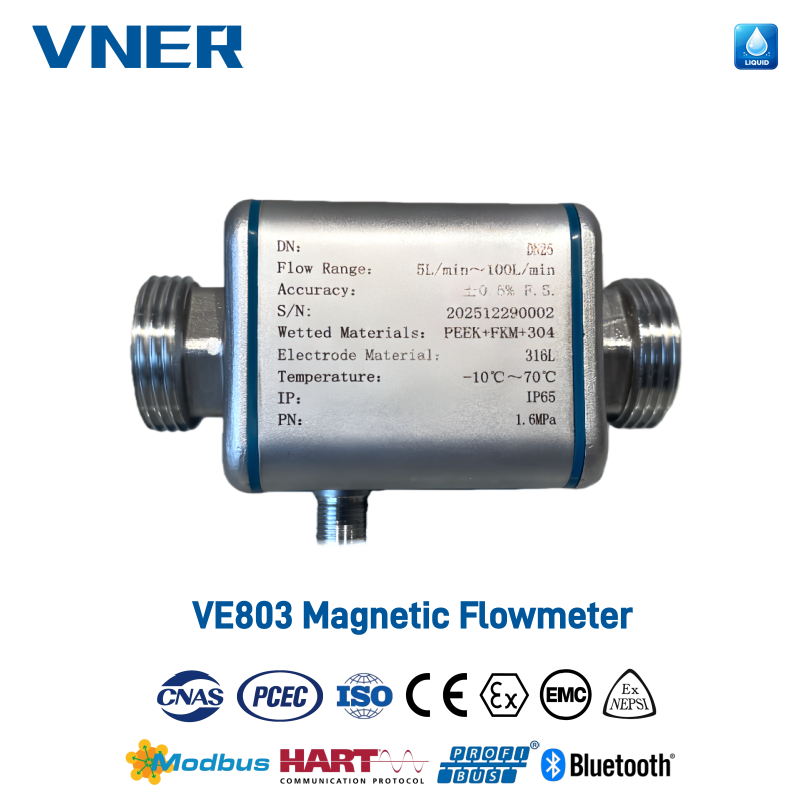 Multi-Parameter Smart Magmeter with BluetoothVE803 compact electromagnetic flowmeter measures flow, temperature, and conductivity with Bluetooth connectivity, compact design, and zer...View Product →
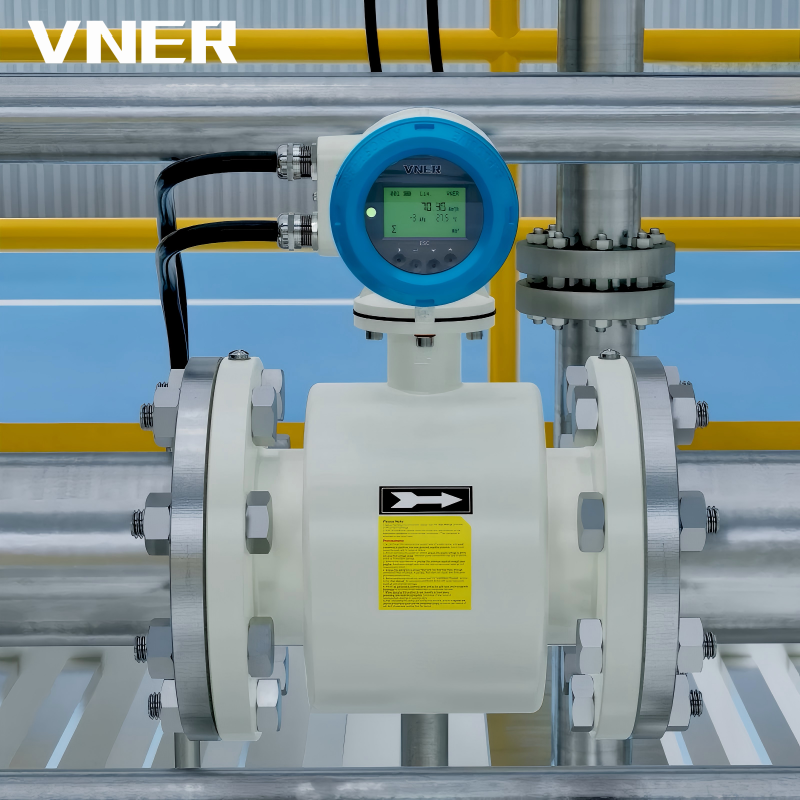 High Accuracy Slurry Electromagnetic Flowmeter Factory, ManufacturersAs China high accuracy electromagnetic flowmeter manufacturers and factory, Jiangsu Vner Electronic Technology wholesale slurry electroma...View Product →
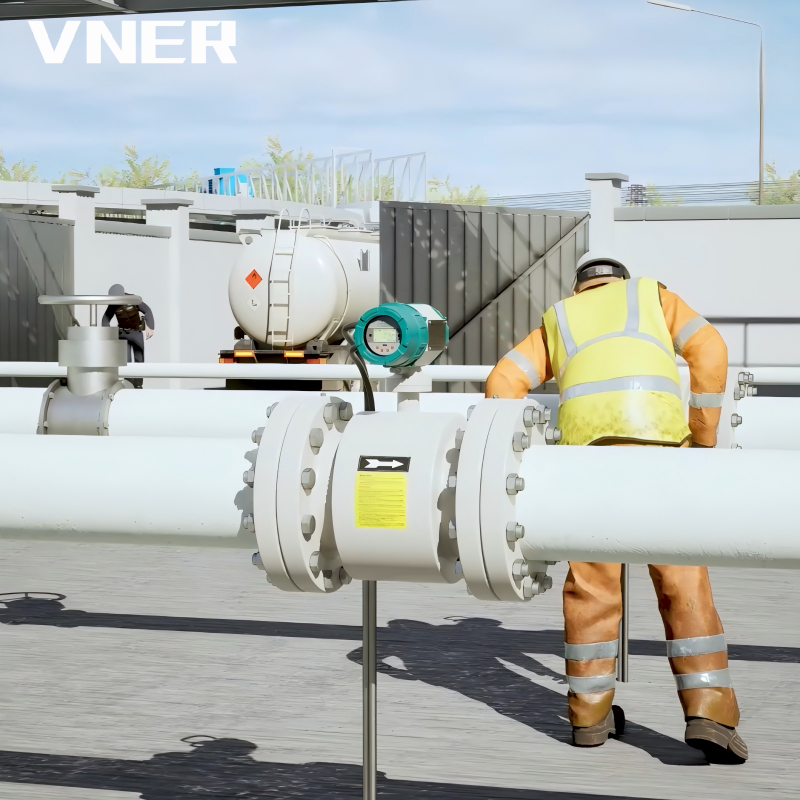 Integrated Electromagnetic Flowmeter Manufacturers, SuppliersJiangsu Vner Electronic Technology is China LDG integrated electromagnetic flowmeter manufacturers and OEM/ODM suppliers, we wholesale co...View Product →
The company's in-house calibration capability is a key advantage. It means your meter can be verified before shipment, and the calibration data is documented. In addition, Vner's website provides details about their industry experience and application support. You can review their water and wastewater application experience and read more about the LDG electromagnetic flowmeter to understand the technical principles behind the product family.
Electromagnetic water flow meters remain the preferred technology for conductive water-based liquids in municipal and industrial settings. Their accuracy, lack of moving parts, and low maintenance provide a strong return on investment when the application is well defined. At the same time, proper installation, grounding, and material selection are essential to achieve the rated performance. By working with an experienced manufacturer and verifying the meter against your application, you can avoid most of the common pitfalls that show up after commissioning.


Products
Contact Information
-

+86 18652789521
+86-0514-83633600 / 83633900 -

+86-0514-83633600 / 83633900
-

s@vner.com.cn
katherine@vner.com.cn -

No. 11 Xingye Road, Chenji Town Industrial Park, Yizheng, Yangzhou, China
