
 0
0
 EN
EN  English
 عربى
عربى Español
 русский
If you need any help, please feel free to contact us
Home / News / Industry News / Flow Rate vs Mass Flow Rate: Differences, Units, and Practical Selection Guide
Flow Rate vs Mass Flow Rate: Differences, Units, and Practical Selection Guide
In a gas distribution station, an operator may see two readings for the same pipeline: 2,500 kg/h on one display and 4,200 m³/h on another. Both instruments are correct, but they are answering different questions. Flow rate and mass flow rate are two distinct ways of quantifying fluid movement, and confusing them leads to sizing errors, incorrect process calculations, and even custody-transfer disputes.
What Is Flow Rate?
Flow rate, in its most common industrial sense, refers to volumetric flow rate: the volume of fluid that passes through a given cross-section per unit of time. The standard SI unit is cubic meters per second (m³/s), but process plants more frequently use cubic meters per hour (m³/h), litres per minute (L/min), or US gallons per minute (GPM).
The basic equation is Q = A × v, where Q is the volumetric flow rate, A is the cross-sectional area of the pipe, and v is the average fluid velocity. This simple relationship explains why flow rate can be measured by velocity-based instruments such as vortex, turbine, and electromagnetic flowmeters. In pipes with a fixed diameter, volumetric flow increases with velocity and decreases when the pipe expands to a larger area.
Because volume depends on temperature and pressure, volumetric flow rate changes as process conditions change. A gas flowing at 20 °C and 1 bar occupies a much larger volume than the same gas at 50 bar. In liquids, the effect is smaller but still present.
What Is Mass Flow Rate?
Mass flow rate is the amount of mass crossing a surface per unit of time. It is expressed in kilograms per second (kg/s), kilograms per hour (kg/h), or tonnes per hour (t/h). Unlike volumetric flow rate, mass flow rate is invariant to changes in temperature and pressure because mass is conserved.
The relationship between the two is m = ρ × Q, where m is the mass flow rate, ρ is the fluid density, and Q is the volumetric flow rate. This means that whenever you know the density of the fluid under actual operating conditions, you can convert between the two values. Because mass is conserved, mass flow rate remains constant even when the velocity or density changes locally, provided the total mass entering and leaving a system is balanced.
In processes where chemical reactions, combustion, or heat transfer are involved, mass flow rate is often the more meaningful quantity. The number of molecules that enter a reactor, the amount of fuel burned in a boiler, and the mass of product transferred between tanks are all governed by mass conservation.
Volumetric Flow Rate vs. Mass Flow Rate: Key Differences
| Property | Volumetric Flow Rate | Mass Flow Rate |
|---|---|---|
| Definition | Volume of fluid passing a point per unit time | Mass of fluid passing a point per unit time |
| Common units | m³/h, L/min, GPM | kg/h, kg/s, t/h |
| Dependence on temperature and pressure | Changes with density | Independent of density |
| Typical measurement technologies | Vortex, turbine, electromagnetic, ultrasonic, differential pressure | Coriolis, thermal mass, or volumetric plus density compensation |
This contrast becomes critical in gas and steam service. A volumetric reading taken at a changing pressure has little meaning unless it is normalised to a reference state, whereas a mass reading remains stable regardless of upstream conditions. For example, a steam line at 10 bar with a volumetric flow of 5 m³/h represents a much larger mass flow than the same volume at 1 bar. If the process is metered without pressure correction, the apparent flow will be incorrect.
How to Convert Between Flow Rate and Mass Flow Rate
The conversion is straightforward when the fluid density is known at the point of measurement:
m = ρ × Q
For example, a water line with a volumetric flow of 100 m³/h at a density of 998 kg/m³ has a mass flow rate of 99,800 kg/h. For a gas, density must be calculated from the equation of state using the actual temperature, pressure, and composition. Many flow computers perform this calculation in real time when a pressure transmitter and a temperature transmitter are added to the system.
A common mistake is to apply a fixed density value to a system where temperature or pressure varies. In gas lines, this can produce errors of 5–10% or more. In steam systems, the error can be even larger because steam density changes dramatically with pressure. For accurate mass-based custody transfer or material balance, direct mass measurement or continuous density correction is required.
In gas measurement, volumetric flow is often converted to a standard reference condition, such as normal cubic meters per hour (Nm³/h) or standard cubic feet per minute (SCFM). This standardisation uses a fixed density based on a defined temperature and pressure, so that flow readings from different locations can be compared. However, standardised flow is not the same as true mass flow unless the reference density is precisely traceable to the fluid composition.
Why the Distinction Matters in Industrial Applications
In hydrocarbon processing, petrochemical plants, power generation, and water treatment, the choice between volumetric and mass flow measurement is not a matter of preference. It depends on the objective:
- For custody transfer and tax or commercial metering, mass flow is preferred because it eliminates the need to correct for pressure and temperature variations.
- For process control in chemical reactions, mass flow is the basis of stoichiometric balance and yield calculation.
- For piping design and compressor sizing, volumetric flow at actual conditions is needed to determine pipe velocity and pressure drop.
- For energy metering, both may be required: mass flow multiplied by specific enthalpy determines thermal energy, while volumetric flow is used for hydraulic calculations.
In natural gas networks, for example, gas is billed on a mass or energy basis, not on raw cubic meters. That is why flow computers apply pressure, temperature, and compressibility corrections to raw volumetric readings, or why modern installations select Coriolis meters for direct mass measurement.
In energy metering, both variables are used. Mass flow is multiplied by the specific enthalpy of the fluid to obtain thermal energy. In steam systems, a change of 1 bar in pressure can shift the enthalpy by enough to affect boiler efficiency calculations. Therefore, the measurement method must correspond to the energy accounting scheme.
Measurement Technologies: Which Meters Report Which Flow Rate?
Industrial flowmeters differ in what they fundamentally sense. Velocity-based meters infer volumetric flow rate from the speed of the fluid. The MA80T series vortex flowmeter is a typical example, widely used for steam, gas, and liquid flow where a robust volumetric reading is sufficient. Similarly, turbine and electromagnetic meters produce a volume-based signal.
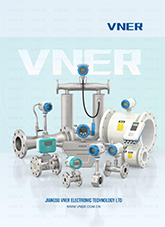 MA80T Industrial Steam Vortex Flowmeter Manufacturers, SuppliersVNER is China MA80T vortex flowmeter manufacturers and OEM/ODM vortex flowmeter suppliers, we custom EAC PAC SIL certified steam vortex f...View Product →
Electromagnetic flowmeters, such as the VE series electromagnetic flowmeter, measure conductive liquids like process water, slurries, and chemical solutions. Their output is proportional to average velocity, hence volumetric flow. They are insensitive to temperature, pressure, and viscosity, but they do not measure mass directly.
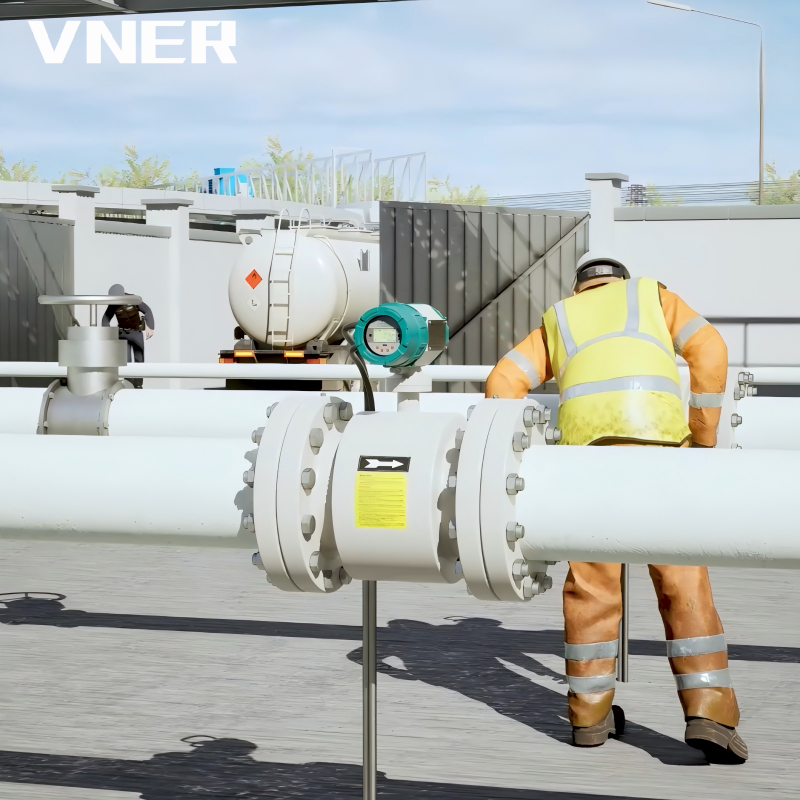 Integrated Electromagnetic Flowmeter Manufacturers, SuppliersJiangsu Vner Electronic Technology is China LDG integrated electromagnetic flowmeter manufacturers and OEM/ODM suppliers, we wholesale co...View Product →
If the process requires true mass flow under varying conditions, Coriolis meters are the most direct answer. The AC series Coriolis mass flowmeter measures mass flow from the phase shift of vibrating tubes, independent of density changes. It also provides a live density output, making it an excellent choice for hydrocarbon loading, chemical dosing, and high-accuracy mass balance applications.
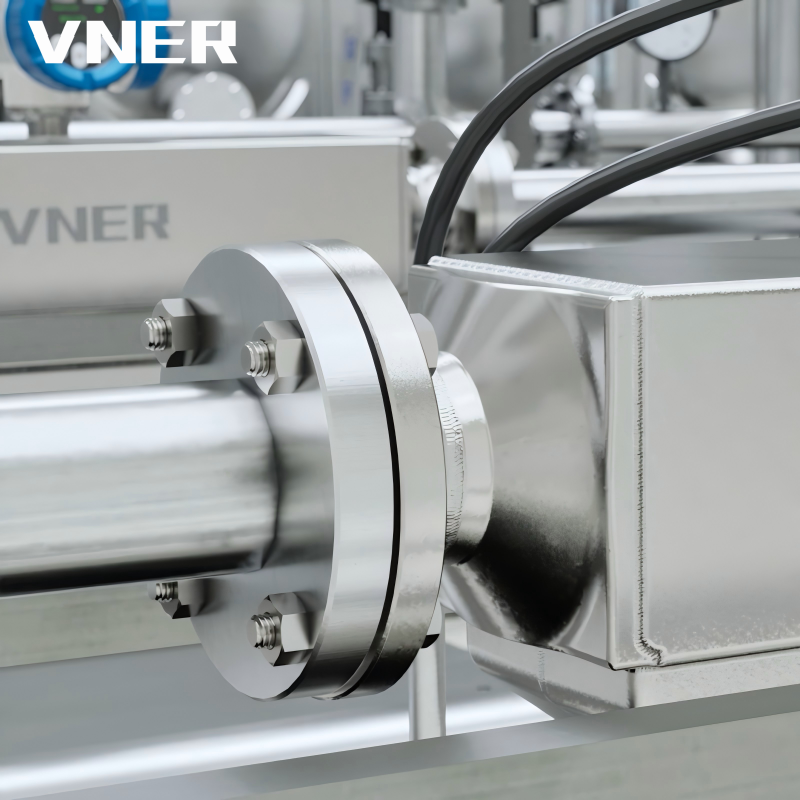 Coriolis mass flow meter for refined products and diesel, ManufacturersAC High-Precision Coriolis Flowmeter delivers direct mass flow, density, and temperature measurement for liquids and gases. Ideal for app...View Product →
Turbine flowmeters are also volumetric devices, using the rotation speed of a freely spinning rotor to infer flow velocity. They perform well with clean, low-viscosity liquids and gases, but their mechanical parts require regular maintenance.
Thermal mass flowmeters, another direct-mass technology, are popular for low-pressure gas lines and compressed air systems. However, they require the gas composition and heat capacity to remain reasonably stable to hold their calibration.
How to Choose the Right Flow Meter
Start by asking one question: is the control or accounting value based on mass or volume? If the answer is mass, then either select a Coriolis meter, or add temperature and pressure compensation to a volumetric meter. If the answer is volume, then a vortex, turbine, or electromagnetic meter may be sufficient and more cost-effective.
The physical properties of the fluid are equally important. Electromagnetic flowmeters only work with conductive liquids, Coriolis meters can handle most clean liquids and slurries, and vortex meters require a sufficiently high Reynolds number to maintain a stable signal. Gas applications often need a different technology than liquid applications.
Accuracy requirements are another key driver. A thermal mass meter may be suitable when repeatability matters more than absolute accuracy, while a Coriolis meter offers the highest accuracy for mass flow and density. The turndown ratio, the range of flow rates the meter can measure accurately, also affects the choice. Vortex and Coriolis meters are known for wide turndowns, while differential pressure systems typically have a narrower range.
For most process plants, the flow measurement strategy combines both concepts: a volumetric meter with temperature and pressure inputs can calculate mass flow in a flow computer, while a Coriolis meter provides direct mass flow for critical streams. VNER offers support for this kind of engineering-driven sizing and selection across process industries, helping you align the measurement principle with the actual process objective.
Flow rate and mass flow rate are not interchangeable; they represent different physical quantities. Volumetric flow is essential for hydraulic and velocity calculations, while mass flow is essential for material balances and custody transfer. The right meter depends on the purpose, the fluid, and the stability of the process conditions. Understanding the difference eliminates a large class of measurement errors and ensures that the number on the control panel actually matches what is happening inside the pipe.


Products
Contact Information
-

+86 18652789521
+86-0514-83633600 / 83633900 -

+86-0514-83633600 / 83633900
-

s@vner.com.cn
katherine@vner.com.cn -

No. 11 Xingye Road, Chenji Town Industrial Park, Yizheng, Yangzhou, China
