
 0
0
 EN
EN  English
 عربى
عربى Español
 русский
If you need any help, please feel free to contact us
Home / News / Industry News / What Makes A Coriolis Mass Flowmeter the Ultimate Solution for High-Accuracy Measurement in Modern Industry?
What Makes A Coriolis Mass Flowmeter the Ultimate Solution for High-Accuracy Measurement in Modern Industry?
Amid the profound transformation of Industry 4.0, fluid measurement precision is no longer just a technical parameter; it has become a core metric for measuring automated production efficiency and intelligent monitoring levels. With its subversive design philosophy, the Coriolis Mass Flowmeter has completely broken the shackles of traditional volumetric measurement, which is often constrained by environmental factors such as temperature, pressure, and fluid density. Currently, this technology is rapidly penetrating high-end manufacturing sectors such as petrochemicals, food and pharmaceuticals, semiconductor manufacturing, and the marine industry, becoming the recognized "gold standard" for complex fluid monitoring. As global industries pivot towards carbon neutrality and waste reduction, the ability to measure mass directly provides the ultimate data foundation for resource optimization and carbon footprint tracking.
What is a Coriolis Mass Flowmeter?
A Coriolis mass flowmeter is a sophisticated precision instrument designed based on classical dynamic principles, specifically the Coriolis effect. In terms of physical essence, it is generations apart from traditional orifice, turbine, or electromagnetic flowmeters. Conventional devices mostly measure fluid "volume," which is highly susceptible to interference from thermal expansion or contraction. In contrast, a Coriolis meter measures the "true mass" of the fluid—a physical quantity that remains constant under any operating condition, whether the fluid is a boiling liquid or a compressed gas.
Internally, its core consists of one or two measuring tubes maintained in a state of precisely controlled vibration. A high-frequency small actuator (drive coil) drives the measuring tubes to vibrate at their specific natural frequency, much like a tuning fork. This design ingeniously utilizes the inertial force generated by fluid particles moving within a vibrating system, converting the abstract attribute of mass into capturable mechanical signals. This direct measurement approach eliminates the need for complex density calculations, providing a "single-source-of-truth" for process engineers.
How Does a Mass Flowmeter Work?
To deeply understand the operational mechanism of this flowmeter, we need to observe the dynamic mechanical behavior of the fluid as it enters the high-frequency vibrating tubes. This process can be subdivided into four core technical stages:
High-Frequency Vibration Excitation: Once the flowmeter starts, the actuator drives the measuring tubes to produce micro-vibrations at a high frequency (typically 400-1000 Hz). In a static state (no flow), the vibration cycles of the entire tube are completely synchronized in both time and space. The sensors at the inlet and outlet detect identical sine waves.
Involvement of Coriolis Force: As liquid or gas begins to flow through the vibrating tubes at high speed, the moving fluid particles, due to inertia, attempt to resist the periodic vibration of the tubes. On the inlet side, the fluid resists being pushed away from the center of vibration; on the outlet side, it resists being pulled back. This interaction force is known in physics as the "Coriolis Force."
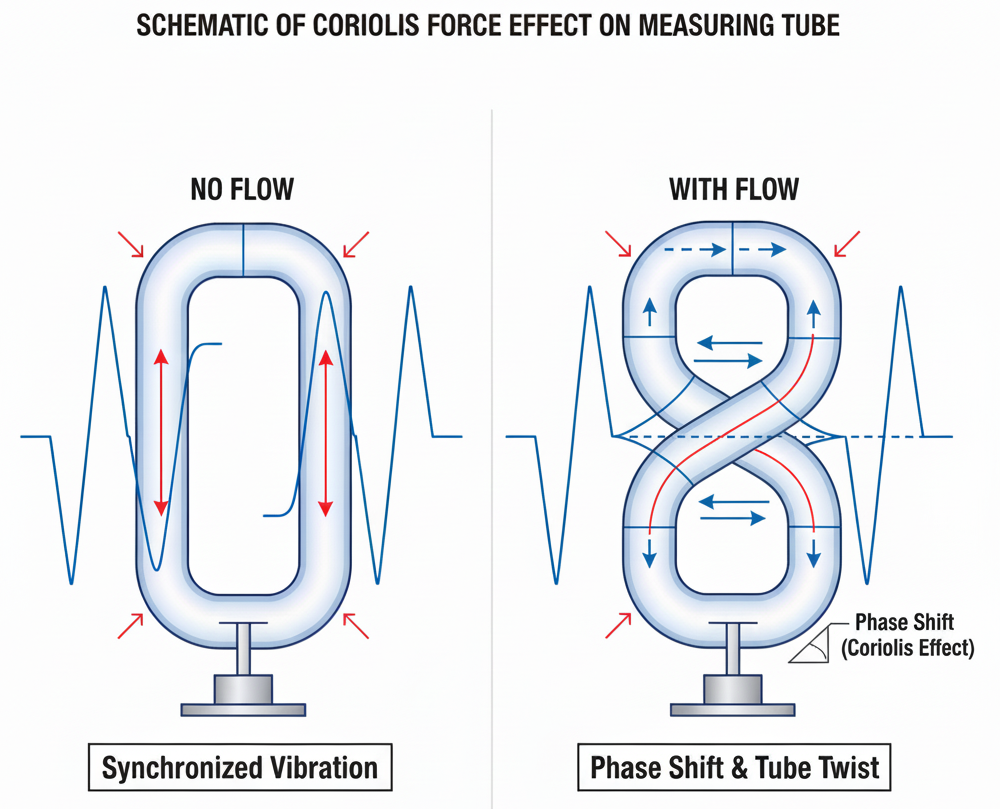
Mechanical Deformation and Twist: The Coriolis force acts in opposite directions on the inlet and outlet halves of the tube, causing the tube to undergo a subtle "twist" or "deformation" that is invisible to the naked eye. This mechanical twisting is directly proportional to the mass flow rate—the more mass moving through, the greater the force, and the more significant the twist.
Phase Shift Conversion and Data Decoding: This deformation disrupts the synchronization between the two ends of the tube. Sensors installed at the inlet and outlet ends capture the "Phase Shift" (time delay) between the two vibration signals. Through high-performance digital signal processing (DSP) chips, the system instantaneously converts this micro-second time difference into extremely accurate mass flow readings, while simultaneously calculating density from the change in natural frequency.
What are the Significant Benefits of Coriolis Flowmeters?
The reason Coriolis flowmeters have replaced traditional ones in many high-end industrial scenarios stems from a combination of nearly uncompromising technical advantages:
Unrivaled Measurement Accuracy and Repeatability: Modern Coriolis meters can provide mass measurement accuracy as high as ±0.1% or even ±0.05%. This level of precision is critical for custody transfer, where even a 0.5% error can lead to millions of dollars in losses over a year. The high repeatability ensures that the manufacturing process remains consistent batch after batch.
Superior Vibration and Environmental Immunity: The internal operating frequency of the instrument is typically set precisely around 400 Hz. This high-frequency operation acts as a natural "filter," allowing the device to distinguish its own measurement signal from the low-frequency mechanical noise common in industrial environments—such as the roar of large pump sets, industrial compressors, or ship main engines. This ensures extremely high reading stability even in the most "noisy" plant conditions.
Simplified Engineering Implementation and Low Lifecycle Maintenance:
- No Straight Pipe Requirements: Unlike turbine or ultrasonic meters that require 10-20 diameters of straight pipe to stabilize flow profiles, a Coriolis meter is independent of the flow profile. In cramped spaces like offshore platforms or ship cabins, this saves massive amounts of space and engineering cost.
- No Moving Parts in the Stream: There are no bearings to wear out or rotors to clog. This results in an incredibly low total cost of ownership (TCO) and high uptime for critical infrastructure.
"Digital Sensor" with Multi-Parameter Integration: A single Coriolis meter provides a "trinity" of data: Mass Flow, Density, and Temperature. By integrating these values, the meter can also output Volume Flow and Concentration, effectively replacing three separate instruments with one digital node.
The VNER AC, AG, and AH Series: Specialized Solutions for Industrial Challenges
To meet the diverse and often extreme demands of modern industry, VNER has developed three specialized series of Coriolis mass flowmeters, each engineered for specific operational environments and regulatory standards.
1. AC Series Coriolis Mass Flowmeter: The Flagship for Versatile Industrial Applications
The AC Series Coriolis Mass Flowmeter represents the pinnacle of VNER's flagship technology, designed to serve as a versatile "workhorse" for high-precision mass flow and density measurement across the broadest range of industrial sectors.
-
Technical Excellence & Signal Integrity: Powered by the A-Series full-digital transmitter platform, it leverages advanced Digital Signal Processing (DSP) to handle ultra-low flow signals with ease. The integrated MFD™ (Multi-Frequency Drive) technology provides exceptional stability even in the presence of entrained gas or gas-liquid two-phase conditions, which typically cause traditional meters to fail.
-
Extreme Specifications: It boasts a mass flow accuracy of up to ±0.05% and can withstand operating pressures up to 15.0 MPa. Its thermal resilience is unmatched, with models capable of operating in cryogenic zones at -196°C or in extreme heat up to +380°C.
-
Key Applications: It is the preferred choice for precision chemical dosing, hydrocarbon blending in refineries, and high-pressure chemical injection skids in demanding offshore environments.
2. AG CNG/LNG Specialized Coriolis Mass Flowmeter: Dedicated for CNG & LNG Fueling
The AG CNG/LNG Specialized Coriolis Mass Flowmeter is a highly specialized line engineered specifically for the natural gas value chain, focusing on the unique challenges of Compressed Natural Gas (CNG) and Liquefied Natural Gas (LNG) custody transfer.
-
High-Pressure & Cryogenic Resilience: The AG CNG015 model is built to survive the extreme pressures of vehicle fueling, rated up to 40.0 MPa. Conversely, the LNG models are optimized for the cryogenic reality of liquid methane, maintaining structural integrity at -196°C to prevent leaks and inaccuracies.
-
Smart Algorithms for Gas Measurement: Featuring the proprietary A-GAS™ algorithm, this series provides ultra-high frequency resolution to eliminate errors typically caused by low gas density and high flow velocity. This ensures a certified batch fueling accuracy of ±0.50%.
-
Key Applications: Essential for CNG dispensers at retail stations, large-scale LNG ship bunkering, and trailer unloading at virtual pipeline satellite stations.
3. AH Hygienic Coriolis Mass Flowmeter: The Standard for Hygienic and Aseptic Processes
The AH Hygienic Coriolis Mass Flowmeter is dedicated to the sanitary world, where cleanliness and precision are equally paramount. It is tailored for the food, beverage, dairy, and pharmaceutical industries.
-
Aseptic Engineering: The sensor features a self-draining, dead-zone-free flow path that eliminates the risk of bacterial growth. Wetted parts are polished to a standard Ra 0.8 μm, with a high-polish Ra 0.38 μm option for the most sensitive pharmaceutical fluids. It is fully CIP/SIP capable, meaning it can undergo repeated high-temperature sterilization cycles without drifting in accuracy.
-
Material & Compliance Integrity: All wetted components are fabricated from SS316/SS316L and are fully compliant with ASME BPE and other global sanitary standards, ensuring the highest level of product safety.
-
Key Applications: Critical for fat standardization in milk processing, precise ingredient dosing in breweries, and buffer preparation in pharmaceutical manufacturing where traceable batch records are mandatory.
Comparison Table of Mainstream Flow Measurement Technologies
|
Feature Dimension |
Coriolis Mass Flowmeter |
Turbine Flowmeter |
Electromagnetic Flowmeter |
Orifice/Differential Pressure |
|---|---|---|---|---|
|
Measured Variable |
Direct Mass |
Volume |
Volume |
Differential Pressure (Indirect) |
|
Typical Accuracy |
±0.1% to ±0.05% |
±0.5% ~ ±1% |
±0.5% |
±1% ~ ±3% |
|
Straight Pipe Req. |
None (0D/0D) |
Very High (10D-20D) |
Moderate (5D-10D) |
High (Over 20D) |
|
Temp/Press Comp. |
Not Required |
Required for Accuracy |
Not Required |
Required for Accuracy |
|
Pressure Loss |
Moderate (Tube geometry) |
High (Rotor) |
Extremely Low (Full bore) |
Extremely High (Orifice) |
|
Maintenance |
Low (Solid-state) |
High (Mechanical wear) |
Low |
Moderate (Clogging/Erosion) |
What Fluids Can a Coriolis Meter Measure?
The Coriolis flowmeter is hailed by the industry as a "universal player." Its robust adaptability means that as long as the material of the measuring tube—ranging from 316L Stainless Steel to Hastelloy C22 or Titanium—is compatible with the corrosiveness of the medium, it can handle almost all conditions:
Extreme Complex Liquid Handling: It excels in measuring high-viscosity polymers that would seize a turbine meter, mining slurries with non-Newtonian fluid characteristics, and abrasive suspensions. In the pharmaceutical sector, its "full-drain" design supports Clean-in-Place (CIP) and Sterilization-in-Place (SIP), ensuring no cross-contamination between batches.
High-Precision Industrial Gas Metering: Gases are highly compressible, making volumetric measurement a nightmare. A Coriolis meter ignores pressure fluctuations and measures the gas molecules directly. This makes it the preferred choice for high-pressure natural gas custody transfer, hydrogen refueling stations, and industrial pure gas distribution.
Dual-Phase Flow Challenges and Frontiers: Historically, "slug flow" or high gas entrainment caused Coriolis meters to stall. However, the next generation of meters utilizes "Multi-Frequency Drive" and advanced DSP algorithms to maintain vibration even when the fluid is a messy mix of oil, water, and gas. This is a breakthrough for the oil and gas industry, particularly in wellhead monitoring where separator equipment is too costly to install.
Frequently Asked Questions about Coriolis Flowmeters
1: Why is a Coriolis meter more expensive than other types? A1: The initial cost is higher due to the complex manufacturing of the vibrating tubes and the sophisticated electronics required for micro-second signal processing. However, when you factor in the lack of straight piping, the removal of temperature/pressure transmitters, and the zero-maintenance design, the "Total Cost of Ownership" is often lower over a 5-year period.
2: Does the orientation of the meter matter during installation? A2: Yes. For liquid applications, the "tubes-down" position is preferred to prevent air bubbles from being trapped. For gas applications, "tubes-up" is best to allow any condensed moisture to drain out. Side-mounting is used for self-draining slurries.
3: Can a Coriolis meter be damaged by air in the line? A3: Generally, no. While air might cause a temporary "measurement error" or "noise" in the signal, it does not mechanically damage the meter. The electronics are designed to recover the signal as soon as the liquid flow returns to normal.
4: Is there a maximum viscosity limit for these meters? A4: There is no theoretical limit to the physics of the Coriolis effect. However, practically, the limit is determined by the pressure drop. Extremely viscous fluids require more pump pressure to move through the meter's curved tubes.
5: How often do I need to re-calibrate a Coriolis meter? A5: Because there are no moving parts to wear out, the "zero point" is incredibly stable. Many industries only re-calibrate every 2 to 5 years, or whenever regulatory requirements dictate. If the meter is not subject to extreme corrosion or erosion, its calibration factor remains remarkably constant.
As the ultimate solution for high-accuracy measurement in modern industry, the widespread adoption of the Coriolis Mass Flowmeter marks a total leap from the "era of crude volumetric metering" to the "era of precise mass control." By providing a single, reliable, and multi-parameter data source, it empowers engineers to optimize their processes with unprecedented granularity. Whether it's ensuring the exact flavor profile of a soft drink or managing the custody transfer of millions of gallons of LNG, the Coriolis meter stands as the most reliable sentinel in the world of fluid dynamics. With the continuous iteration of sensing technology and computing power, this intelligent device will undoubtedly play an irreplaceable role in the green factories and global energy transition of the future.


Products
Contact Information
-

+86 18652789521
+86-0514-83633600 / 83633900 -

+86-0514-83633600 / 83633900
-

s@vner.com.cn
katherine@vner.com.cn -

No. 11 Xingye Road, Chenji Town Industrial Park, Yizheng, Yangzhou, China
