
 0
0
 EN
EN  English
 عربى
عربى Español
 русский
If you need any help, please feel free to contact us
Flow Measurement Solutions for 10 Types of Water
Engineering Selection Guide for Chemical, Utility & Industrial Applications
Accurate flow measurement plays a critical role across water treatment, chemical processing, utilities, and environmental industries. However, not all “water” behaves the same. Differences in conductivity, mineral content, purity, corrosiveness, hygiene requirements, and installation constraints directly affect flow meter selection and long-term measurement stability.
From an instrumentation engineering perspective, proper selection must balance:
-
Measurement accuracy requirements
-
Fluid conductivity and cleanliness
-
Installation space and pipe conditions
-
Budget and lifecycle maintenance cost
-
Process reliability and compliance
This guide provides a practical engineering overview of 10 common water types, matched with suitable measurement technologies and application-oriented instrument selection.
1. Pure Water
Applications: semiconductor, pharmaceutical, laboratory systems
Characteristics: ultra-low conductivity, high purity
Challenges:
-
Conductivity often too low for standard EMF
-
Contamination-sensitive systems
-
High accuracy dosing requirements
Recommended solutions:
-
A Series Coriolis → precision dosing and batching
-
VNFT Ultrasonic → non-intrusive measurement
-
SR41 Rotameter → local visual indication on skid systems or lab lines

Engineering note
Rotameters are widely used in skid-mounted pure water distribution panels where simple local indication is sufficient and zero power consumption is preferred.
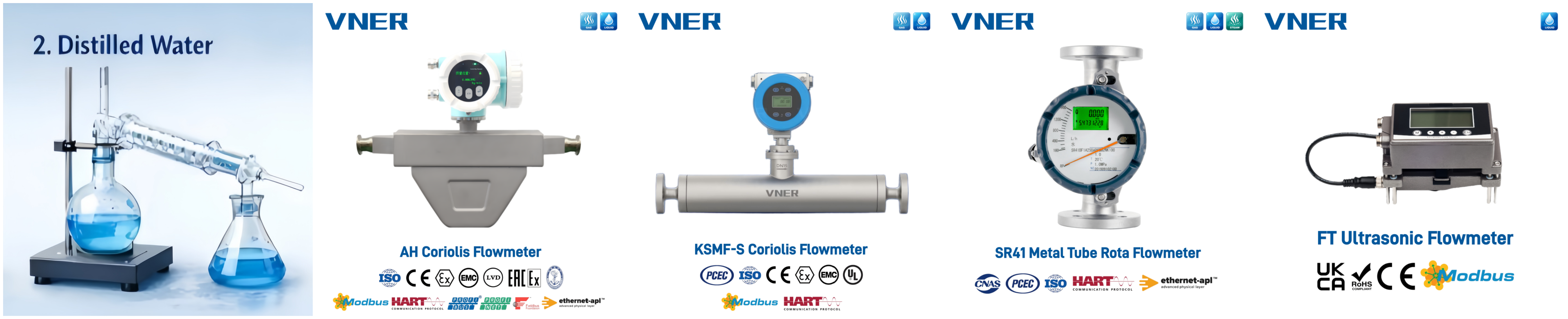
2. Distilled Water
Applications: laboratory, medical, battery manufacturing
Characteristics: low conductivity, clean systems
Recommended solutions:
-
AH / KSMF-S Hygienic Coriolis for precision dosing
-
Ultrasonic for transfer lines
-
SR41 Rotameter for laboratory or small process lines
Engineering note
Compact electromagnetic meters are often selected in packaged equipment due to limited installation space.
3. Deionized (DI) Water
Applications: power plant boiler feed, electronics manufacturing
Characteristics: very low conductivity, closed-loop systems
Recommended solutions:
-
VNFT Ultrasonic for pipeline transport
-
AC or AH Coriolis for dosing
-
SA80T Swirl for stable compact installations
-
SR41 Rotameter for skid-mounted polishing units

Engineering note
For DI polishing skids and point-of-use systems, rotameters remain widely accepted due to simplicity and zero conductivity dependence.
4. Soft Water
Applications: HVAC, boiler feed, cooling systems
Characteristics: stable conductivity, low scaling
Recommended solutions:
-
VE Premium Series EMF for main pipelines
-
VE803 Compact EMF for skid systems and OEM equipment
-
VE801 Economic EMF for cost-sensitive utility projects
-
Swirl for thermal or compact installations

Engineering insight
Soft water provides ideal conditions for electromagnetic technology, allowing stable long-term measurement with minimal maintenance.
5. Hard Water
Applications: municipal supply, mining, cooling water
Characteristics: high mineral content, scaling risk
Recommended solutions:
-
VE Premium EMF with anti-scaling liner
-
VE801 Economic EMF for municipal and bulk water projects
-
Swirl meters for robust operation in scaling conditions

Engineering note
Economic electromagnetic models are widely used in large municipal or industrial distribution networks where budget control is essential.
6. Natural Water (River / Raw Water)
Applications: intake systems, irrigation, water treatment
Characteristics: suspended solids, variable conductivity
Recommended solutions:
-
VE Premium EMF for treatment plants
-
VE801 / LDG Economic EMF for large distribution networks
-
Ultrasonic for large diameter pipelines

Engineering note
Rotameters are frequently used for coagulant and dosing water monitoring in treatment skids.
7. Seawater
Applications: desalination, offshore, marine cooling
Characteristics: high salinity, strong corrosion
Recommended solutions:
-
VE Premium EMF with corrosion-resistant liner and electrodes
-
Ultrasonic for large pipelines
-
Swirl for auxiliary systems

Engineering note
High conductivity makes seawater ideal for electromagnetic measurement when appropriate materials are selected.
8. Drinking (Potable) Water
Applications: municipal supply, distribution, food & beverage
Characteristics: hygienic requirements, stable conductivity
Recommended solutions:
-
VE Premium EMF for main billing lines
-
VE13E Hygienic Electromagnetic Flow Meter for food, beverage and hygienic water systems
-
VE803 Compact EMF for skid-mounted treatment units
-
Ultrasonic for trunk pipelines

Engineering insight
Hygienic electromagnetic designs are preferred in food, beverage, and pharmaceutical water systems where cleanability and sanitary connections are required.
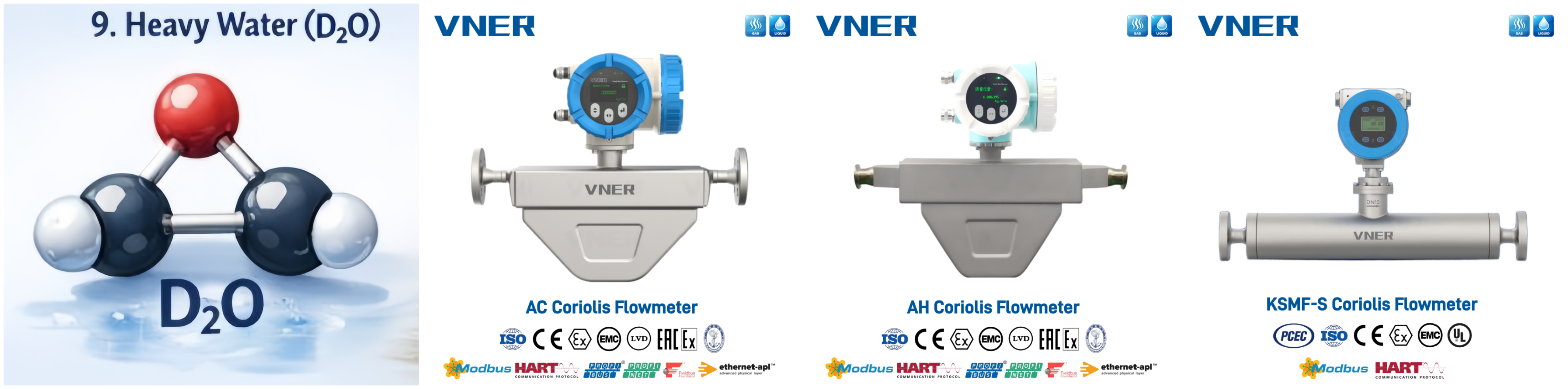
9. Heavy Water (D₂O)
Applications: nuclear and research facilities
Characteristics: high-value fluid, density monitoring required
Recommended solution:
-
A Series Coriolis mass flow meter
-
KSMF Series Coriolis mass flow meter
Engineering note
Mass flow and density measurement are essential for high-value or nuclear-grade fluids.
10. Wastewater / Industrial Effluent
Applications: WWTP, chemical plants, environmental systems
Characteristics: solids, sludge, corrosive media
Recommended solutions:
-
VE Premium EMF (primary)
-
VE801 Economic EMF for municipal wastewater networks
-
Ultrasonic for large channels
-
Swirl/vortex for supporting utility lines

Supporting dosing & treated water discharge
- LWGY Liquid Turbine Flow Meter for clean treated water discharge and reuse systems
- SR41 Rotameter for chemical dosing lines
Engineering insight
Turbine flow meters are often used for clean treated water or reuse water where conductivity may be low but stable flow and cost efficiency are required.
Supporting Utility & Skid Applications
Water systems often include auxiliary measurement points:
| Application | Recommended instrument |
| Chemical dosing skids | SR41 Rotameter / Coriolis |
| Clean treated water | LWGY Turbine |
| Threaded connection | VE803 Compact EMF |
| Budget projects | VE801 Economic EMF |
| Food/pharma water | VE13E Hygienic EMF |
| Steam / hot water | SA80T Swirl / MA80T Vortex |
Key Selection Factors for Water Flow Measurement
| Factor | Engineering Consideration |
|---|---|
| Conductivity | Determines EMF suitability |
| Hygiene requirement | Hygienic EMF or Coriolis |
| Pipe size | Ultrasonic for large diameter |
| Budget | Economic EMF or turbine |
| Accuracy requirement | Coriolis for high precision |
| Maintenance access | Rotameter for simple local indication |
Conclusion
Each type of water presents different measurement challenges and requires appropriate flow measurement technology. Selecting the right instrument depends on conductivity, cleanliness, installation conditions, accuracy requirements, and lifecycle cost considerations.
With a comprehensive portfolio including electromagnetic, Coriolis, vortex, swirl, ultrasonic, turbine, and rotameter technologies, VNER provides reliable and optimized flow measurement solutions across the full spectrum of water applications — from ultra-pure laboratory systems to large-scale municipal and industrial wastewater treatment.
As industries worldwide continue to prioritize efficiency, sustainability, and operational reliability, advanced flow measurement remains a key component of modern water management and process control.

Products
Contact Information
-

+86 18652789521
+86-0514-83633600 / 83633900 -

+86-0514-83633600 / 83633900
-

s@vner.com.cn
katherine@vner.com.cn -

No. 11 Xingye Road, Chenji Town Industrial Park, Yizheng, Yangzhou, China
