
 0
0
 EN
EN  English
 عربى
عربى Español
 русский
If you need any help, please feel free to contact us
Home / News / Industry News / Why is the Swirl Flowmeter the Preferred Solution for Precision Gas and Steam Measurement?
Why is the Swirl Flowmeter the Preferred Solution for Precision Gas and Steam Measurement?
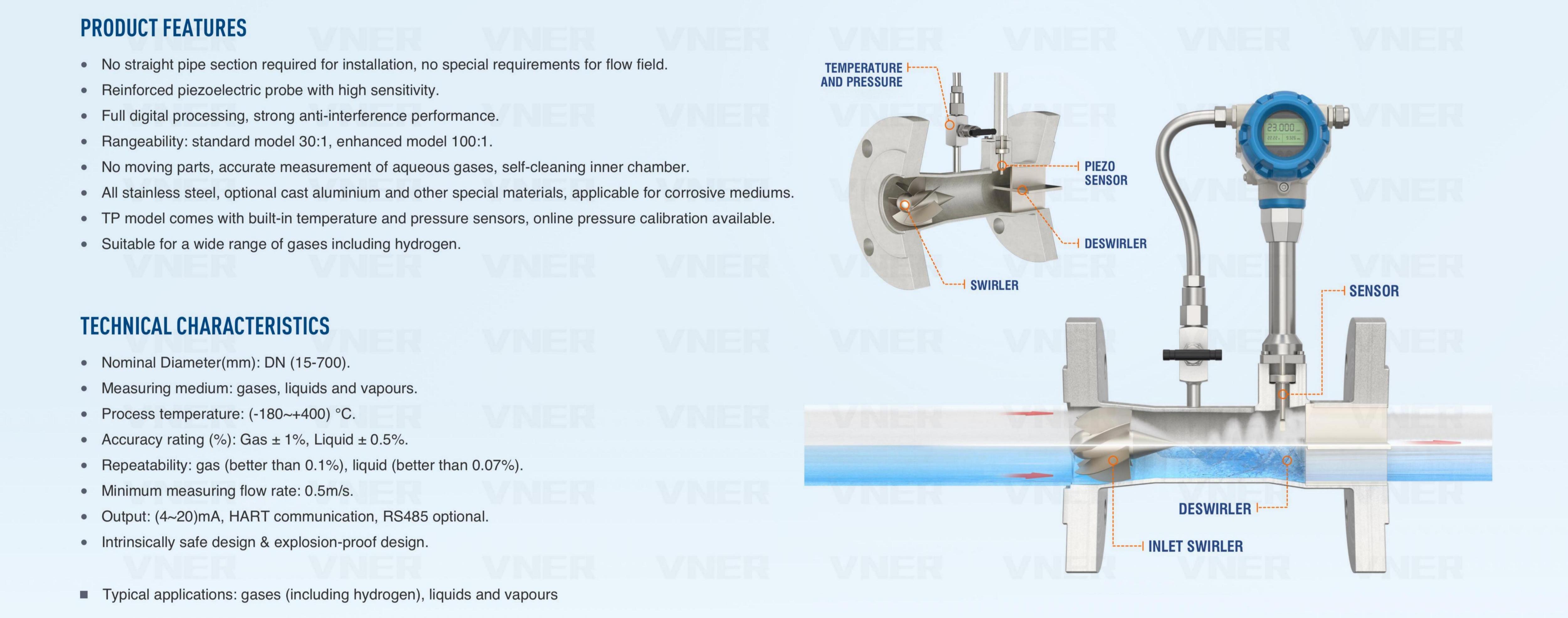
In the specialized field of fluid dynamics, the Swirl Flowmeter stands out due to its unique "vortex precession" principle, offering high accuracy and a wide turndown ratio. The introduction of the SA80T-TP Series represents a significant leap forward, moving beyond simple volumetric measurement. This series is the temperature and pressure compensated version of the standard SA80T, specifically designed to address the complexities of measuring compressible fluids like steam and industrial gases. By integrating multiple sensing elements into a single unit, it simplifies installation while drastically improving the reliability of the data used for process control and cost allocation.
How Does the SA80T-TP Series Achieve Superior Pressure Compensation?
A primary challenge in measuring gases and steam is their compressibility; their density changes significantly with fluctuations in temperature and pressure. The Pressure Compensation Swirl Flowmeter solves this by performing real-time calculations.
Is the Integrated Sensor Design More Effective Than External Transmitters?
Based on the same high-efficiency swirl generator and sensor design as the standard SA80T, the SA80T-TP integrates built-in temperature and pressure measurement directly into the flow body. Traditional setups often require separate pressure transmitters and RTDs (Resistance Temperature Detectors) installed downstream, which introduces potential leak points and additional wiring complexity. The integrated approach of the Swirl Flowmeter ensures that the temperature and pressure are measured at the exact point where the swirl frequency is detected, leading to a much more accurate real-time density calculation.
What are the Primary Technical Specifications of the SA80T-TP Series?
To understand how this Swirl Flowmeter compares to its predecessors, we can look at the core functional parameters in the following table:
|
Feature |
Standard SA80T |
SA80T-TP Series (Compensated) |
|---|---|---|
|
Measurement Principle |
Vortex Precession |
Vortex Precession + TP Compensation |
|
Temperature Sensor |
Not Integrated |
Built-in PT1000 / RTD |
|
Pressure Sensor |
Not Integrated |
Built-in Absolute/Gauge Pressure |
|
Flow Outputs |
Operating Volumetric Flow |
Mass Flow, Standard Volume, Volumetric |
|
Media Capability |
Stable Liquids and Gases |
Steam, Compressed Air, Natural Gas |
|
Density Calculation |
Fixed Constant |
Real-time Thermodynamic Correlation |
|
Application Focus |
General Flow Monitoring |
Energy Metering & Cost Allocation |
Why is Real-Time Density Calculation Vital for Steam and Gas Networks?
In energy metering, measuring "how much space the fluid takes up" (volumetric flow) is often less important than "how much energy or mass is being moved." This is where the Swirl Flowmeter with integrated compensation becomes indispensable.
How Does the Converter Process Multi-Variable Inputs?
The converter unit of the SA80T-TP is the "brain" of the system. It takes the frequency signals from the swirl sensor and combines them with the data from the internal temperature and pressure sensors. Using pre-configured media parameters—such as the properties of saturated steam or specific gas compositions—the device applies standard thermodynamic correlations to calculate the fluid's instantaneous density. This allows the Swirl Flowmeter to provide mass flow and standard volume flow outputs alongside the conventional operating volumetric flow.
Can the SA80T-TP Handle Both Saturated and Superheated Steam?
Steam systems are notoriously difficult to monitor because steam can transition between saturated and superheated states depending on boiler performance and pipe insulation. The SA80T-TP Swirl Flowmeter is particularly suitable for these environments. Because it continuously monitors both temperature and pressure, it can determine the state of the steam and apply the correct density tables. For saturated steam, where temperature and pressure are linked, the dual-sensor setup provides a redundancy check that ensures accuracy even if one parameter fluctuates unexpectedly.
What Makes the Swirl Flowmeter Ideal for Energy Metering and Cost Allocation?
Accuracy in "Energy Metering" is the cornerstone of industrial cost management. When factories share a central boiler or compressed air plant, precise "Cost Allocation" depends on the flowmeter's ability to normalize data.
How Does Standard Volume Flow Improve Cost Transparency?
Compressed air and gas networks often experience pressure drops across long piping runs. A standard Swirl Flowmeter without compensation would report different volumes at the start and end of the pipe, even if no gas was lost. The SA80T-TP converts all readings to "Standard Volume Flow" (e.g., Nm³/h or SCFM), which refers to a fixed reference pressure and temperature. This ensures that every department or tenant is billed based on the actual quantity of gas molecules consumed, regardless of local pressure fluctuations.
Why is the "Vortex Precession" Principle Inherently Robust?
The swirl generator at the inlet of the Swirl Flowmeter forces the incoming fluid into a rotating motion. As the fluid enters the expansion section, the center of the swirl performs a gyroscopic precession. The frequency of this precession is directly proportional to the flow rate. Unlike turbine meters, there are no moving parts that can wear out or seize up. Unlike orifice plates, there are no sharp edges to erode. This makes the SA80T-TP a low-maintenance solution for high-velocity steam and "dirty" industrial gases where other sensors might fail.
How Do Configured Media Parameters Ensure Application Versatility?
The flexibility of the SA80T-TP Series lies in its software-driven compensation engine, which can be tailored to the specific fluid in the pipe.
What Thermodynamic Correlations Are Used for Accuracy?
The device utilizes industry-standard formulas to ensure the highest degree of precision. Whether it is the IAPWS-IF97 tables for water and steam or the AGA/SGERG standards for natural gas, the Swirl Flowmeter performs these complex calculations internally. Users simply configure the media parameters during commissioning, and the meter handles the rest, staying within the calibrated limits of the installed sensors and the actual process conditions.
Can the SA80T-TP Be Integrated into Modern Process Control Systems?
In a modern smart factory, the Swirl Flowmeter acts as a data hub. Because it outputs mass flow, temperature, and pressure, it can provide three sets of data via a single digital interface (such as HART, Modbus, or 4-20mA signals). This multi-variable output is essential for sophisticated "Process Control" loops. For example, in a chemical reactor where a specific mass of gas is required for a reaction, the SA80T-TP provides the direct mass flow value, eliminating the need for the PLC to perform external compensation calculations, thereby reducing system latency and potential programming errors.
Does the SA80T-TP Simplify Installation in Restricted Spaces?
Space is often at a premium in industrial manifolds and skid-mounted equipment. The design of the SA80T-TP Swirl Flowmeter addresses these physical constraints directly.
Is the Requirement for Straight Pipe Runs Reduced?
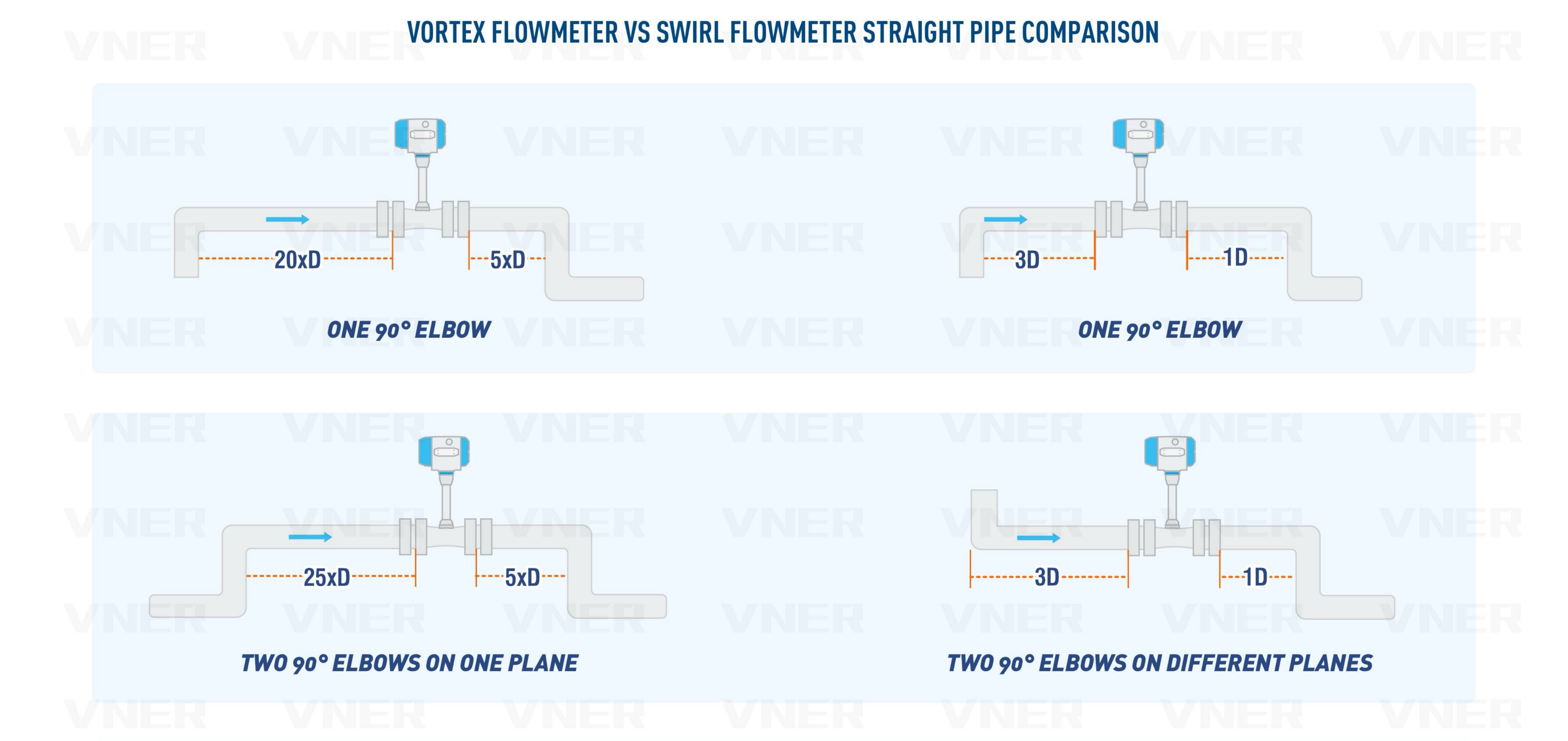
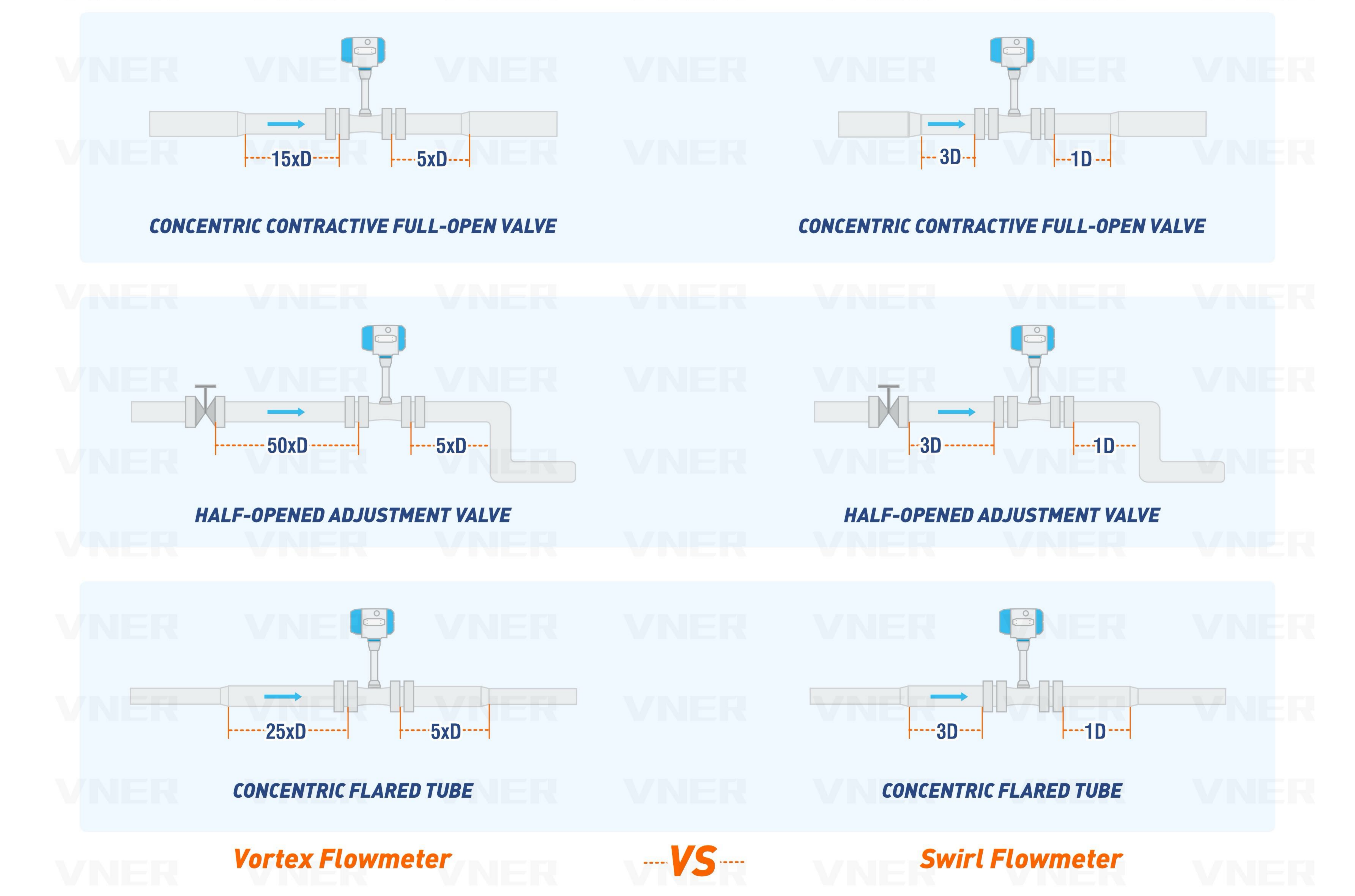
Compared to standard vortex flowmeters, the Swirl Flowmeter is generally less sensitive to upstream flow disturbances because the swirl generator effectively "re-profiles" the fluid velocity as it enters the meter. When you combine this with the integrated temperature and pressure sensors, the "footprint" of the measurement point is drastically reduced. There is no need for extra straight pipe sections to accommodate separate pressure or temperature taps, making the SA80T-TP an excellent choice for retrofitting into existing compressed air or steam lines where space is limited.
How Does Built-in Compensation Reduce Total Cost of Ownership?
While the initial purchase price of a Pressure Compensation Swirl Flowmeter may be higher than a basic volumetric meter, the "Total Cost of Ownership" is often lower. By eliminating the need for separate sensors, specialized mounting hardware, and additional cabling, the total installation cost is reduced. Furthermore, the increased accuracy in energy balance and cost allocation prevents "invisible" losses in steam and gas networks, providing a rapid return on investment through improved efficiency.


Products
Contact Information
-

+86 18652789521
+86-0514-83633600 / 83633900 -

+86-0514-83633600 / 83633900
-

s@vner.com.cn
katherine@vner.com.cn -

No. 11 Xingye Road, Chenji Town Industrial Park, Yizheng, Yangzhou, China
