
 0
 EN
 English
 عربى
 Español
 русский
If you need any help, please feel free to contact us
Home / News / Industry News / BTU Meter Guide: How Thermal Energy Meters Measure Flow, Temperature, and Heat
BTU Meter Guide: How Thermal Energy Meters Measure Flow, Temperature, and Heat
A chilled-water plant can lose more energy through a mismatched temperature sensor pair than through a slightly worn pump. That is why a BTU meter should be treated as a thermal energy measurement system, not as a flow meter with a temperature readout added. It answers a commercial and engineering question: how much heat was actually transferred, and who should pay for it? The short answer is that a BTU meter multiplies flow by temperature difference and by the fluid's heat capacity, then totalizes the result. The practical answer depends on sensor matching, installation, fluid properties, and the way the meter is verified after commissioning.
What a BTU meter measures, in practical terms
A BTU meter measures thermal energy in a closed liquid loop, usually water or a water-glycol mixture. It combines three inputs: volumetric flow, the temperature at the supply side, and the temperature at the return side. The calculator applies the relationship Q = V × ΔT × k, where Q is thermal energy, V is fluid volume, ΔT is the temperature difference, and k accounts for density and specific heat. For clean water the factor is predictable; for glycol, the concentration must be known because specific heat and density change with mixture ratio.
The meter usually reports two values: instantaneous thermal power in BTU/h or kW, and accumulated energy in BTU or kWh. Both matter. A building operator may use BTU/h to see whether a coil is delivering design capacity. A billing team uses accumulated BTU to allocate cost. If flow reads correctly but ΔT is wrong, the energy total is wrong even when the flowmeter itself is accurate. If ΔT is correct but flow is low, the supplier may underbill and the customer may overpay. That is why a BTU meter is only as reliable as its weakest input.
The three measurement elements and their failure modes
Flow sensor
The flow sensor sets the volume side of the calculation. Electromagnetic meters are common in conductive water loops because they have no moving parts and handle dirty or mildly aggressive fluids well. Ultrasonic meters suit retrofit work and large pipes where cutting in a spool is expensive. Turbine and other mechanical options can be cost-effective in clean, stable flows, but they need filtration and a maintenance plan. The selection should start with pipe size, minimum and maximum flow, conductivity, temperature, pressure, and straight-run availability.
For a packaged electromagnetic option, VNER lists the VE12 electromagnetic heat meter for BTU thermal energy measurement. The selection still depends on pipe size, conductivity, temperature, and required output; the product card is a starting point, not a substitute for sizing.
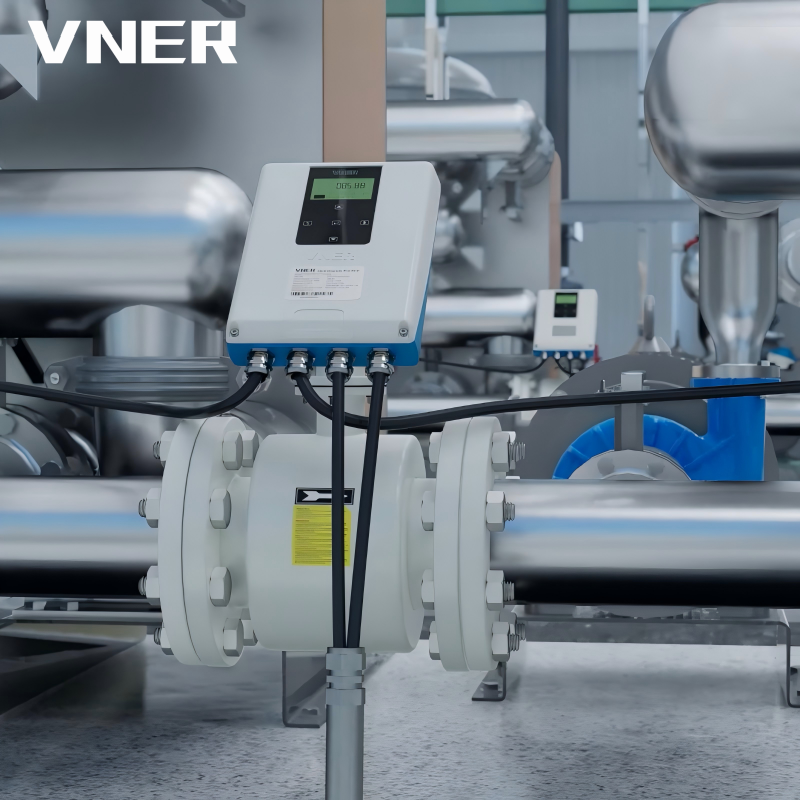 VE12 Electromagnetic Heat Meter for BTU Thermal EnergyView the VE12 for conductive-liquid heating and cooling energy metering; confirm pipe size, conductivity, temperature, output, and matched temperature-sensor installation.View Product →
Temperature sensors
The two temperature sensors must be treated as a matched pair. A mismatch of 0.1°C looks small until the design ΔT is only 5°C; at that point the error is about 2% of the energy reading. At a 10°C ΔT the same mismatch is about 1%. Installation depth, thermowell contact, insulation, and sensor calibration all affect the result. A sensor that is too short for the pipe or sitting in a stagnant pocket will report a temperature that is stable but wrong.
Energy calculator
The calculator integrates flow and ΔT, stores totals, and provides outputs for building management, billing, or SCADA. It should be checked for calculation interval, memory retention, pulse or Modbus output, power failure behavior, and access control. A calculator that loses its total after a power interruption creates disputes that are difficult to resolve. For tenant billing or custody transfer, verification and audit trails matter as much as accuracy specifications.
BTU/h, BTU, and kWh: units that change procurement
One kilowatt-hour equals about 3,412 BTU. That conversion matters when a meter is specified in one unit but the billing system works in another. It also helps when comparing proposals: a lower-priced meter that only displays BTU/h may require external integration to produce billable totals, while a meter with onboard BTU totalization may cost more upfront but reduce commissioning work.
| Readout | What it means | Procurement impact |
|---|---|---|
| BTU/h | Instantaneous thermal power at the moment of reading. | Useful for capacity checks, but not enough for billing. |
| BTU | Accumulated thermal energy over time. | Needed for cost allocation, efficiency tracking, and reconciliation. |
| kWh | Metric equivalent of accumulated energy. | Check conversion and totalizer scaling before commissioning. |
| ΔT | Supply-to-return temperature difference. | Reveals sensor mismatch, low load, or bypass flow problems. |
Where BTU meters earn their cost
District heating and cooling
District systems depend on fair allocation across many buildings and heat exchangers. A BTU meter at each transfer station turns flow and temperature into a defensible energy total. The main risks are sensor placement, water quality, and access for verification. In cooling networks, condensate and low ΔT operation can make temperature pairing especially important.
Commercial HVAC and tenant billing
In office towers, campuses, and mixed-use developments, BTU meters support tenant billing and performance checks on chillers, boilers, and air-handling systems. A meter that is accurate in the laboratory but installed without enough straight run or with uninsulated sensors will not deliver reliable billing data. Commissioning should include a load test at realistic ΔT, not only a no-flow check.
Industrial process and renewable loops
Process plants use thermal energy measurement for steam condensate, cooling water, heat recovery, and reactor jackets. Renewable loops add another layer: solar thermal, biomass, and heat-pump systems often run variable temperatures, so the meter must handle turndown and glycol concentration changes. For teams comparing industrial applications, the site's industry application overview is a useful starting point before specifying a meter.
Sizing and selection: the numbers to settle before price
Start with the operating envelope, not the catalog page. The goal is to choose a meter that stays within its accuracy range at the lowest expected flow and does not over-range at peak demand.
- Design flow, minimum flow, and turndown ratio for the actual loop.
- Pipe size and material, plus available straight run and installation orientation.
- Design ΔT, supply and return temperatures, and expected low-load conditions.
- Fluid type, glycol percentage, conductivity, solids, and chemical compatibility.
- Pressure rating, temperature rating, and any hazardous-area or metrology approval.
- Outputs, power supply, display location, data logging, and billing access control.
A lower-cost meter that is oversized for the minimum flow can be a false economy. So can a high-accuracy meter with unmatched temperature sensors. The right specification balances flow turndown, ΔT range, verification interval, and maintenance access.
Accuracy, installation, and maintenance risks
Most BTU meter problems appear after commissioning, not on the datasheet. Air pockets, reversed sensor positions, uninsulated thermowells, and wrong pipe dimensions can all distort the energy total. So can a changed glycol mix after a maintenance refill. If the calculator was configured for 30% glycol and the loop now runs 20%, the specific heat factor is wrong and every BTU total inherits that error.
- Confirm sensor insertion depth and direct contact with the flowing fluid.
- Verify supply and return sensor assignment before taking billing data.
- Check straight run and flow direction after any pump or valve change.
- Record glycol concentration and update the calculator if the mixture changes.
- Inspect insulation and thermowell pockets for corrosion or water ingress.
Calibration should be planned around risk, not only around annual routines. For billing and custody applications, review flow meter calibration methods, tolerances, and traceability before setting the verification interval. Keep a spare matched temperature sensor pair for critical loops; replacing one sensor with an unmatched unit can undo a careful commissioning job.
Procurement and lifecycle checks
The purchase price is only one line in the lifecycle cost. Ask for the verification method, expected recalibration interval, spare parts availability, and the configuration record. A meter that cannot be read without proprietary software may become a liability when the building changes hands.
- Require a commissioning record with flow, ΔT, and totalizer checks.
- Confirm the unit of measure and totalizer scaling in writing.
- Check whether the calculator retains totals through power loss.
- Verify that temperature sensors are supplied and replaced as a matched pair.
- Plan access for inspection, cleaning, and recalibration before installation.
For multi-tenant or district systems, also agree on dispute resolution: who witnesses verification, what tolerance is acceptable, and how estimated data will be handled during downtime. These are commercial controls, but they determine whether the BTU meter is trusted after the project handover.
A BTU meter is only as good as the installation around it. The flow sensor, matched temperature sensors, and calculator must be selected as one system, then commissioned at realistic load. When that happens, the meter becomes more than a display: it becomes a defensible record of thermal energy, a tool for efficiency decisions, and a fair basis for cost allocation.


Products
Contact Information
-

+86 18652789521
+86-0514-83633600 / 83633900 -

+86-0514-83633600 / 83633900
-

s@vner.com.cn
katherine@vner.com.cn -

No. 11 Xingye Road, Chenji Town Industrial Park, Yizheng, Yangzhou, China
