
 0
0
 EN
EN  English
 عربى
عربى Español
 русский
If you need any help, please feel free to contact us
Gas Turbine Flowmeter: How It Works, Specs and Selection Guide
A gas turbine flowmeter measures the volumetric flow rate of a gas by detecting the rotational speed of a turbine rotor placed in the flow stream. As gas passes through the meter body, it exerts force on the angled blades of the rotor, causing it to spin at a speed directly proportional to the gas velocity. For clean, dry gases in high-velocity pipelines where accuracy, wide turndown ratio, and compact installation are priorities, the gas turbine flowmeter is one of the most reliable and well-proven measurement technologies available. It is the instrument of choice for natural gas custody transfer, industrial process gas metering, compressed air measurement, and fuel gas allocation in power generation and petrochemical facilities. Understanding how it works, what specifications govern selection, where it performs best, and what its limitations are gives engineers and procurement teams the foundation to specify this instrument correctly and extract its full measurement capability.
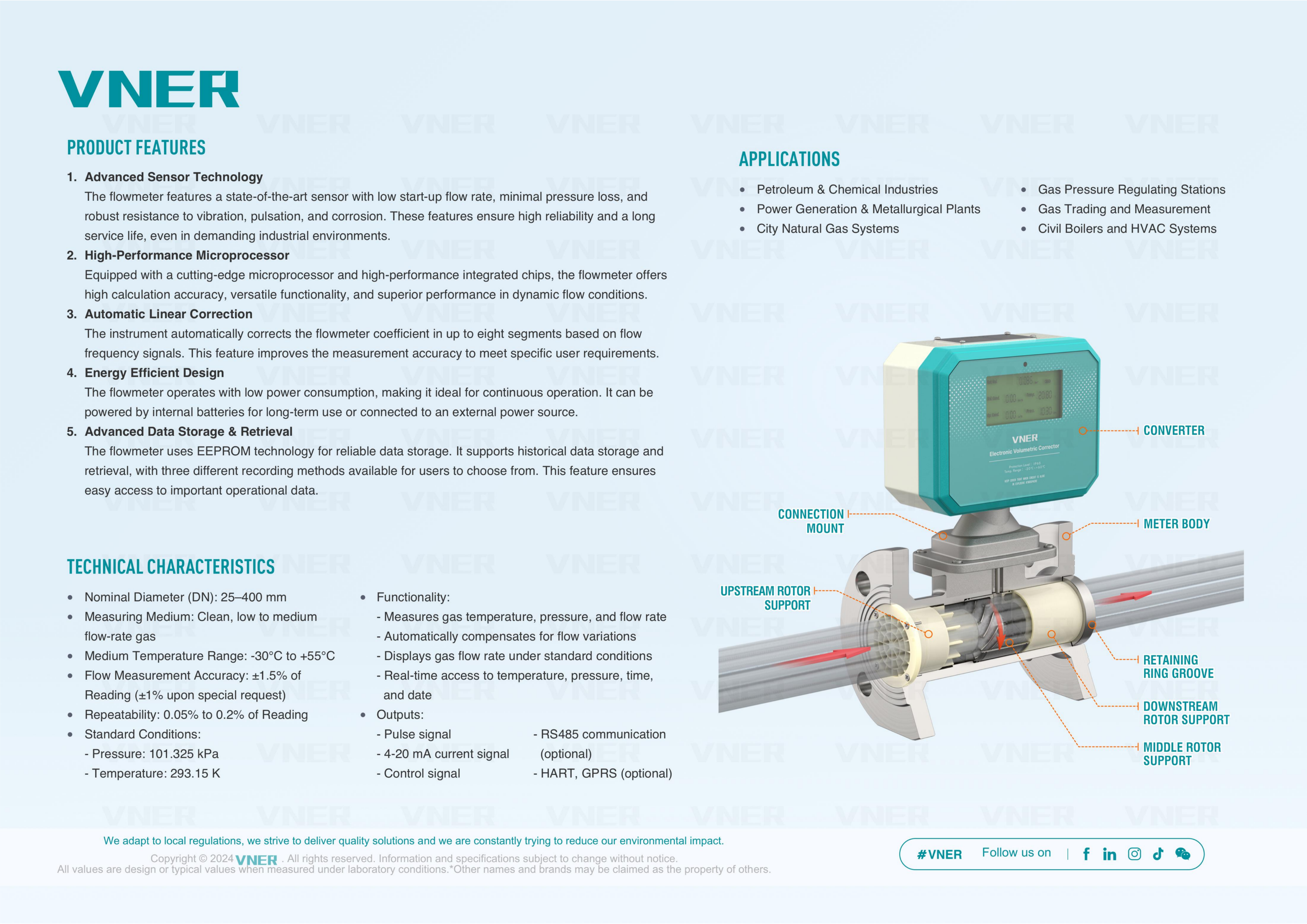
Operating Principle of a Gas Turbine Flowmeter
The operating principle of a gas turbine flowmeter is based on the transfer of kinetic energy from a moving gas stream to a mechanical rotor. The rotor is mounted on a shaft within the meter body, with its axis aligned with the direction of flow. The rotor blades are set at a fixed helix angle, typically between 30 and 45 degrees to the flow axis, so that gas impinging on the blades generates a torque that causes the rotor to spin. At steady flow, the rotor reaches an angular velocity at which the driving torque from the gas balances the retarding torques from bearing friction, magnetic drag from the pickup sensor, and fluid drag on the blade surfaces. At this equilibrium, rotor speed is very nearly proportional to gas velocity over a wide range of flow rates.
The K Factor and Its Role in Metering
The relationship between rotor rotational frequency and volumetric flow rate is expressed through the meter factor, commonly called the K factor. The K factor is defined as the number of pulses generated per unit volume of gas that passes through the meter, typically expressed as pulses per cubic meter or pulses per liter. For a well-manufactured gas turbine flowmeter, the K factor is stable and linear across the meter's specified flow range, which is what makes the instrument suitable for high-accuracy custody transfer applications. The K factor is determined during calibration on a certified flow calibration rig and is stated on the meter's calibration certificate. A typical gas turbine flowmeter maintains K factor linearity within plus or minus 0.5 to 1.0% across its stated flow range, with some high-accuracy meters achieving plus or minus 0.25% or better across a portion of their range.
Signal Detection Methods
The rotation of the turbine rotor must be converted to an electrical signal without mechanical contact that would introduce friction and wear. Three detection methods are used in commercial gas turbine flowmeters:
- Variable reluctance magnetic pickup: A permanent magnet embedded in a coil assembly mounted in the meter body generates a voltage pulse each time a rotor blade tip passes beneath it, as the blade tip changes the magnetic reluctance of the circuit. This method requires no external power, generates a self-powered signal, and is highly reliable. It is the standard detection method for most gas turbine flowmeters in industrial and utility applications.
- Hall effect sensor: A magnetically activated semiconductor device detects the passage of blade tips using the Hall effect. Hall effect pickups require a small power supply but provide cleaner signal edges at low rotor speeds, extending the meter's low-flow measurement capability beyond what variable reluctance pickups can achieve. Used in applications where low-flow accuracy is critical.
- RF (radio frequency) capacitance pickup: A high-frequency oscillator detects the change in capacitance as each rotor blade passes the sensor face. This contactless method provides very accurate blade counting at both low and high speeds and is used in some precision and custody transfer meters where the widest possible linear range is required.
Key Specifications and What They Mean in Practice
Specifying a gas turbine flowmeter correctly requires understanding the real meaning of each performance specification and how it translates to measurement quality in the specific application. Manufacturers use consistent terminology but the practical implications are sometimes obscured by marketing language.
Flow Range and Turndown Ratio
The flow range of a gas turbine flowmeter is defined as the span between the minimum flow rate at which the stated accuracy applies (Qmin) and the maximum continuous flow rate (Qmax). The ratio of these two values is the turndown ratio. Most commercial gas turbine flowmeters achieve turndown ratios of 10:1 to 20:1, with some precision models achieving 30:1 or higher using advanced rotor bearing design and Hall effect or RF pickup systems. A turndown ratio of 20:1 means that a meter sized to measure a maximum flow of 200 m³/h will also accurately measure flows down to 10 m³/h within its stated accuracy specification. This wide rangeability is one of the primary competitive advantages of the turbine flowmeter over differential pressure devices, which typically deliver only 3:1 to 5:1 turndown before losing acceptable accuracy at low flows.
Accuracy and Repeatability
Accuracy for gas turbine flowmeters is typically stated as a percentage of reading (percent of rate) rather than a percentage of full scale. This distinction matters significantly: a meter with plus or minus 1.0% of reading accuracy maintains that error across the entire flow range, while a meter with plus or minus 1.0% of full scale accuracy has a much larger relative error at low flows. For custody transfer applications, OIML R137 and AGA-7 (American Gas Association Report No. 7) specify that custody transfer turbine meters must achieve accuracy within plus or minus 1.0% of reading across the flow range, with the best-performing meters achieving plus or minus 0.5% or better. Repeatability, which describes the meter's ability to produce the same reading for the same flow condition on repeated measurements, is typically better than accuracy, often at plus or minus 0.1 to 0.2% for quality turbine meters. High repeatability is essential for proving (in-field verification of meter performance using a master meter) and for applications where flow consistency rather than absolute accuracy is the primary requirement.
Pressure and Temperature Ratings
The meter body and internals must withstand the maximum operating pressure and temperature of the application without structural failure or dimensional change that would alter the K factor. Gas turbine flowmeters for natural gas service are typically available in pressure ratings of PN16, PN25, PN40, and Class 150/300/600 to ASME B16.5, covering line pressures from atmospheric to over 100 bar in some configurations. Temperature ratings for standard industrial models span from approximately minus 20 to plus 60 degrees Celsius for electronics and from minus 40 to plus 120 degrees Celsius for the mechanical body in high-temperature service variants. Cryogenic service meters for liquefied natural gas (LNG) vapor measurement extend to minus 196 degrees Celsius using stainless steel bodies and specially selected bearing and rotor materials.
Pipe Size Range
Gas turbine flowmeters are manufactured in standard line sizes from approximately 15 mm (0.5 inch) to 600 mm (24 inch) nominal bore, with wafer-body designs for smaller sizes and flanged full-bore bodies for larger nominal diameters. The selection of meter size is not necessarily the same as the pipeline nominal bore: turbine meters should be sized so that the normal operating flow falls in the upper half of the meter's stated flow range, where linearity is best, rather than at or near the maximum flow rate which risks exceeding the rated continuous duty and accelerating bearing wear.
Applications Where Gas Turbine Flowmeters Excel
Gas turbine flowmeters have been in commercial production since the 1950s and have accumulated a long field record across diverse industries. Their combination of accuracy, rangeability, and relatively compact installation footprint makes them the preferred choice in the following application categories.
Natural Gas Custody Transfer and Fiscal Metering
The most significant application of gas turbine flowmeters globally is the custody transfer of natural gas between producers, transmission companies, distribution companies, and large industrial consumers. At custody transfer measurement stations, the meter's output is used directly to calculate the monetary value of gas transferred, making accuracy and traceability to national measurement standards mandatory. AGA-7 is the industry standard governing turbine flowmeter design, performance, and installation for natural gas custody transfer in North America. ISO 9951 covers the same application internationally. These standards specify calibration traceability, uncertainty budgets, installation requirements, and proving procedures that form the contractual basis for accurate billing between gas trading partners.
A typical custody transfer installation uses two or three turbine meters in parallel with automated stream switching and a dedicated meter prover for in-service calibration verification. The prover allows the K factor to be checked against a certified volume standard without removing the meter from service, ensuring that any drift in meter performance is detected and corrected before it results in a significant metering error that would require financial settlement between the parties.
Industrial Process Gas Measurement
In chemical, petrochemical, and pharmaceutical manufacturing, gas turbine flowmeters measure nitrogen, oxygen, hydrogen, argon, carbon dioxide, and mixed process gases in pipeline systems serving reactors, heat exchangers, purge systems, and blanketing systems. Their ability to handle high-pressure clean gases and their compact body dimensions make them practical where space is constrained by existing piping layouts. In burner management systems for industrial furnaces and boilers, turbine meters provide the flow signal used to calculate air-to-fuel ratios that are optimized for combustion efficiency and emissions compliance.
Compressed Air and Instrument Gas Systems
Compressed air is one of the most energy-intensive utilities in manufacturing, and gas turbine flowmeters installed in compressed air distribution headers allow energy managers to quantify consumption by production area, identify leakage, and benchmark energy efficiency improvements. The meter measures actual volume at line pressure and temperature, and when combined with a pressure and temperature transmitter and a flow computer, provides corrected volumetric flow in standard cubic meters per hour or standard cubic feet per minute that represents the true amount of air consumed regardless of system pressure variations during peak demand periods.
Power Generation Fuel Gas Metering
Gas-fired power plants use turbine flowmeters to measure fuel gas supply to each gas turbine and boiler. Accurate fuel measurement is required for heat rate calculation, efficiency monitoring, and emissions reporting under environmental permit conditions. The flow measurement from the turbine meter, combined with gas analysis from a chromatograph, allows calculation of the energy content of the gas consumed per hour, which directly determines plant thermal efficiency and fuel cost per megawatt-hour of generation. A one percent error in fuel gas measurement at a 400 MW combined cycle plant consuming approximately 70,000 m³/h of natural gas represents a billing error equivalent to hundreds of thousands of dollars annually at typical gas prices, which explains the investment in high-quality custody-transfer-grade turbine meters at power generation facilities.
Limitations and Applications Where Turbine Meters Are Not the Best Choice
The gas turbine flowmeter's dependence on mechanical rotation means it has inherent limitations in certain service conditions that must be honestly assessed when comparing it against alternative technologies for a specific application.
Dirty, Wet, or Corrosive Gases
Gas turbine flowmeters require clean, dry gas to function reliably. Particulate contamination from pipe scale, construction debris, or process carryover damages the rotor blades and bearing surfaces, causing progressive K factor drift and eventual mechanical failure. Entrained liquids cause similar damage and can create abrupt K factor shifts as liquid slugs pass through the meter. Corrosive gas components including hydrogen sulfide, chlorine, and acidic compounds attack bearing materials and can cause rotor seizure if the wetted materials are not specifically selected for corrosion resistance. Before specifying a turbine meter in any gas service, the gas composition including potential contaminants must be confirmed as compatible with the meter's rotor material, shaft material, and bearing type. Gas that cannot be guaranteed clean and dry at the meter inlet should be measured by a technology with no moving parts such as an ultrasonic meter or a vortex meter.
Pulsating Flow
Reciprocating compressors and positive displacement pumps generate pressure pulsations in the downstream piping that cause periodic acceleration and deceleration of the gas stream. A turbine rotor, due to its inertia and blade angle geometry, responds to pulsating flow by over-registering: it accelerates when gas velocity increases and decelerates more slowly when velocity decreases, producing a systematic positive metering error. In severely pulsating conditions this error can reach 5 to 10% or more, which is entirely unacceptable for custody transfer or process control purposes. Pulsation dampeners installed upstream of the meter, or selection of an ultrasonic meter that has no moving rotor susceptible to inertial effects, are the remediation options for pulsating flow environments.
Very Low Flow Rates and Low Reynolds Numbers
Below the turbine meter's Qmin specification, bearing friction and drag forces become significant relative to the driving force from the gas stream, causing the rotor to decelerate below the speed proportional to flow velocity. The K factor deviates from its calibrated value and measurement error increases rapidly. Applications where flow regularly falls below 10% of Qmax for extended periods are poorly served by turbine meters. Thermal mass flowmeters or Coriolis meters are better suited to low-flow gas measurement where the turbine meter's minimum flow threshold is not consistently achievable.
Installation Requirements for Accurate Measurement
Gas turbine flowmeters are sensitive to the velocity profile of the gas at their inlet. A fully developed, symmetric, swirl-free velocity profile entering the meter ensures that the rotor responds uniformly across all blade segments and that the K factor matches the calibrated value. Disturbed profiles caused by upstream piping fittings create asymmetric or swirling flow that shifts the effective K factor and introduces systematic measurement error that no amount of electronic adjustment can fully correct.
Straight Pipe Run Requirements
The minimum straight pipe runs required upstream and downstream of a gas turbine flowmeter depend on the type and severity of the upstream disturbance. AGA-7 provides specific guidance for common piping configurations:
| Upstream Disturbance | Minimum Upstream Straight Run | Minimum Downstream Straight Run |
|---|---|---|
| Single 90-degree elbow | 10D | 5D |
| Two elbows in same plane | 20D | 5D |
| Two elbows in different planes | 25D | 5D |
| Control valve (partially open) | 30D | 5D |
| Reducer (2:1 reduction) | 5D | 5D |
Where the required straight pipe length cannot be achieved due to piping space constraints, a flow conditioner installed upstream of the meter can significantly reduce the required straight run by breaking up swirl and redistributing velocity profile distortions. Flow conditioners conforming to ISO 17089 or AGA-7 appendix recommendations reduce the upstream requirement to approximately 10D following the conditioner in most piping configurations, at the cost of a small permanent pressure drop across the conditioner element.
Orientation and Mounting Position
Gas turbine flowmeters can be installed in any pipe orientation including horizontal, vertical upward, and vertical downward flow, provided the meter is designed for the orientation. Horizontal installation is the most common and generally preferred because it avoids the potential for liquid accumulation at the meter inlet that can occur with vertical downward flow in gas lines that carry traces of condensate. If vertical installation is required, upward flow is preferred over downward flow to ensure that any liquid present drains away from the rotor rather than pooling at the blade tips. The meter must be installed in a location accessible for maintenance and inspection without the need for scaffolding or temporary pipe isolation that would interrupt service.
Volume Correction and Temperature and Pressure Compensation
A gas turbine flowmeter measures the actual volume of gas passing through the meter at line conditions of pressure and temperature. In most commercial and industrial applications, the quantity of interest is not the actual volume at line conditions but the standard volume or mass corrected to a reference condition, typically 0 degrees Celsius and 101.325 kPa (standard cubic meters) or 15 degrees Celsius and 101.325 kPa depending on the applicable contract or regulatory standard.
The Role of the Flow Computer
A flow computer receives the pulse signal from the turbine meter along with pressure and temperature signals from transmitters installed at or near the meter, and applies the real gas equation of state to calculate the corrected volume or mass flow in real time. The compressibility factor Z of the gas, which accounts for the deviation of real gas behavior from ideal gas behavior at elevated pressures, must be calculated from a gas composition equation such as AGA-8 (for natural gas) to achieve the accuracy required for fiscal metering. At a line pressure of 70 bar, the compressibility factor of natural gas may be approximately 0.85, meaning the actual volume at line conditions is only 85% of the volume that ideal gas calculations would predict, and neglecting compressibility would introduce a 15% systematic error into every metering calculation at that pressure. Accurate flow computer implementation of AGA-8 or equivalent equation of state is therefore as important to overall system accuracy as the calibration quality of the turbine meter itself.
Energy Measurement Integration
For natural gas applications where the commercial transaction is based on energy content rather than volume, the flow computer extends its calculation to energy flow by multiplying the standard volumetric flow rate by the calorific value of the gas. Calorific value is derived from gas chromatograph analysis of the composition either at the metering station itself or from a representative value agreed between parties. The energy measurement chain from turbine meter pulse through volume correction to energy calculation is the core function of a fiscal metering system and is audited against national measurement standards during commissioning and at subsequent proving intervals.
Maintenance and Bearing Life
The primary maintenance requirement of a gas turbine flowmeter is the rotor bearing system. The rotor spins continuously at high speed during operation, and the bearings that support the rotor shaft are subject to wear that eventually requires replacement. The rate of bearing wear determines the meter's maintenance interval and the stability of the K factor over time, making bearing quality one of the most important design parameters in a high-reliability gas turbine flowmeter.
Bearing Types and Their Longevity
Three bearing types are used in commercial gas turbine flowmeters, each with different performance and longevity characteristics:
- Sleeve (journal) bearings: Hydrodynamic bearings in which a thin film of gas or lubricant supports the rotor shaft. In clean dry gas service, the process gas itself provides lubrication, eliminating the need for external lubricant supply and preventing contamination of the gas stream. Sleeve bearings in clean natural gas service can achieve lives of five to ten years or more before requiring replacement.
- Ball bearings: Rolling element bearings provide low friction at startup and low flow rates, extending the meter's useful range toward lower flow velocities than sleeve bearings can sustain. However, ball bearings require lubrication that must be supplied either from a separate lubricant reservoir within the meter body or from a lubricant mist in the process gas, and they are more susceptible to contamination damage than sleeve bearings in dirty gas applications.
- Ceramic bearings: Zirconia or silicon carbide ceramic bearings offer excellent wear resistance, chemical inertness, and the ability to operate without lubrication in corrosive or dry gas environments where conventional metallic bearings would suffer rapid wear or corrosion attack. Ceramic bearings are increasingly specified for sour gas (hydrogen sulfide containing) and corrosive gas applications.
Condition Monitoring and Predictive Maintenance
Modern gas turbine flowmeter designs incorporate a dual-rotor or dual-pickup configuration that provides a means of detecting bearing degradation or rotor damage in service without removing the meter for inspection. In a dual-rotor meter, two rotors are placed in series within the meter body. Under normal conditions, both rotors spin at rates determined by the gas flow, and the ratio of their speeds is fixed by their blade angles. When bearing wear or rotor damage begins to affect one rotor differently from the other, the ratio of their rotation speeds changes, providing a diagnostic signal that indicates developing mechanical problems before measurement accuracy is significantly impaired. This predictive maintenance capability allows operators to plan bearing replacement during scheduled maintenance outages rather than responding reactively to meter failure events, which in custody transfer service can trigger costly meter change-out procedures and potential billing disputes.
Calibration, Proving, and Traceability
The accuracy of a gas turbine flowmeter used in custody transfer or fiscal metering is only as good as the calibration that established its K factor curve and the proving program that verifies the K factor remains stable throughout its service period. Calibration and proving are distinct but complementary activities that together provide the metrological traceability required for legally enforceable commercial transactions.
Factory Calibration
Factory calibration is performed on a flow calibration facility using a reference medium, typically air or natural gas, with a traceable master meter or volume standard as the reference. The calibration establishes the K factor at multiple flow rates across the meter's range, producing a calibration table or polynomial correction curve that is stored in the meter's electronic transmitter or the associated flow computer. Calibration certificates must state the reference standard used, its traceability to national or international measurement standards, the uncertainty of the reference standard, and the expanded uncertainty of the meter's calibrated K factor at each tested flow rate. For meters intended for custody transfer, calibration must be performed on gas at conditions representative of service pressure to avoid density effects on the K factor that are not captured by air calibration at atmospheric pressure.
In-Service Proving
Meter proving verifies the K factor of a meter installed in service against a calibrated prover device or a master meter of known calibration, without removing the meter from the pipeline. Pipe provers, small volume provers, and master meter provers are the three principal proving methods used for gas turbine flowmeters in custody transfer service. The proving frequency required under applicable regulations and commercial agreements varies but typically ranges from monthly to annually depending on the size of the metered transaction and the stability history of the meter. Proving results are compared to the established K factor, and if the deviation exceeds the agreed tolerance (typically plus or minus 0.25 to 0.5% depending on the contract), the meter factor is adjusted and the discrepancy may trigger a billing correction for the measurement period since the last valid proving.
Gas Turbine Flowmeter Selection Checklist
Selecting a gas turbine flowmeter for a specific application requires systematic evaluation of the process conditions, performance requirements, and installation constraints. The following checklist covers the critical parameters that must be defined before a specification can be completed:
- Define the gas composition and confirm cleanliness: Identify all components including trace contaminants, condensate potential, and corrosive species. Confirm that the gas can be guaranteed clean and dry at the meter inlet throughout all operating conditions.
- Establish the flow range including minimum, normal, and maximum rates: Confirm that the required flow range is within the achievable turndown of a single meter size, or plan for multiple meters in parallel with automated stream switching if the required range exceeds what a single meter can cover.
- Specify the accuracy and rangeability requirements: Determine whether the application requires fiscal-grade plus or minus 0.5% accuracy or whether a process-grade plus or minus 1.0% or plus or minus 2.0% specification is acceptable, as this directly affects meter cost.
- Confirm maximum operating pressure and temperature: Verify that the meter pressure and temperature ratings exceed the maximum upset conditions, not merely the normal operating conditions.
- Assess available straight pipe runs: Survey the installation site to confirm that the required upstream and downstream straight runs can be achieved, or plan for flow conditioner installation if they cannot.
- Determine output signal and integration requirements: Confirm whether the pulse output will connect directly to a flow computer, a DCS input card, or a SCADA system, and specify the required output format (frequency, HART, Modbus, or pulse-count).
- Specify the proving method and interval: For custody transfer meters, the proving method must be agreed with the trading parties before the meter and prover are specified, as some proving methods impose specific requirements on the meter body design.
The gas turbine flowmeter remains one of the most accurate, reliable, and cost-effective technologies for high-velocity clean gas measurement across the full range from small industrial installations to large-diameter natural gas transmission metering stations. Its mechanical simplicity, well-understood error sources, wide rangeability, and mature calibration and proving infrastructure have sustained its role as the dominant technology in natural gas fiscal metering for over six decades, and nothing on the current market offers a sufficiently compelling combination of competing advantages to displace it from this position in the foreseeable future for the applications where it genuinely excels.


Products
Contact Information
-

+86 18652789521
+86-0514-83633600 / 83633900 -

+86-0514-83633600 / 83633900
-

s@vner.com.cn
katherine@vner.com.cn -

No. 11 Xingye Road, Chenji Town Industrial Park, Yizheng, Yangzhou, China
